


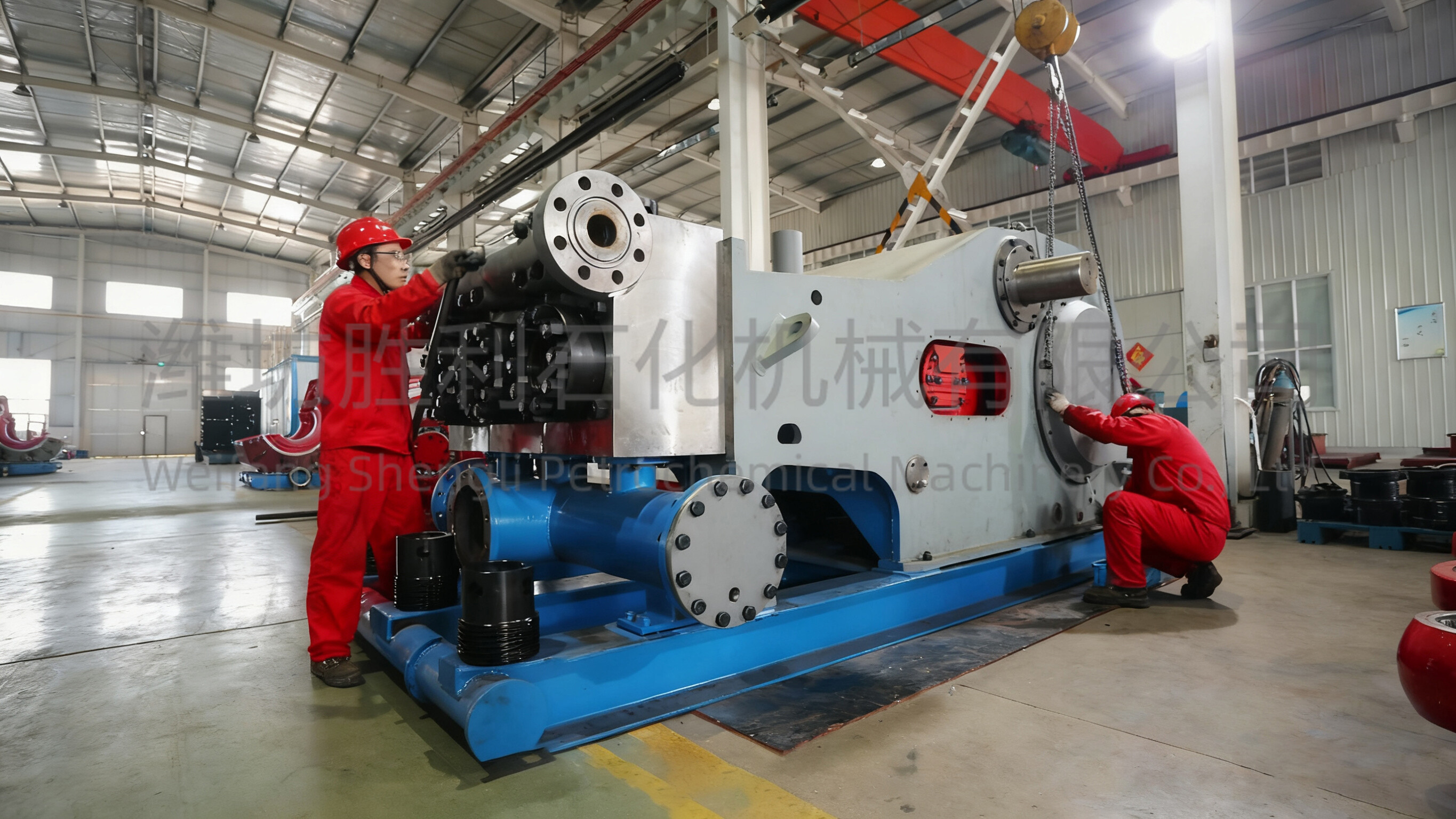
The Technical Definition: What is a Mud Pump?A mud pump is a large, reciprocating positive displacement pump used to circulate drilling fluid (commonly known as "mud") under high pressure down the drill string and back up the annulus. This circulation is critical for cooling the drill bit, cleaning the hole by bringing rock cuttings to the surface, and maintaining hydrostatic pressure to prevent formation fluids from entering the wellbore.
Core Architecture of a Complete Mud Pump SystemA complete mud pump unit operates through the synchronized action of two primary sections:
The Power End: Houses the crankshaft, connecting rods, crossheads, and bearings. It converts the rotational mechanical energy from the rig's motors into the reciprocating linear motion required by the fluid end.
The Fluid End: The section that physically moves the abrasive drilling fluid. It contains the pistons, liners, valves, and seats. Because this section handles highly abrasive and corrosive fluids, it is engineered from high-strength forged steel.
Triplex Mud Pumps: The Industry StandardWhile duplex (two-cylinder) pumps were historically common, the Triplex (three-cylinder) mud pump is now the industry standard for modern drilling rigs. The key advantages of a Triplex configuration include:
Reduced Pulsation: Three alternating strokes provide a smoother discharge flow, minimizing harmful vibrations in the high-pressure rotary hose and standpipe manifold.
Lighter Weight: Triplex pumps typically offer a higher horsepower-to-weight ratio compared to older duplex designs, making rig moves more efficient.
Higher Efficiency: They are capable of handling higher volumes and operating at greater pressures, which is essential for deep-well and horizontal drilling.
Technical FAQ: Mud Pump Operations
What is the function of the pulsation dampener on a mud pump?The pulsation dampener is a critical component installed on the discharge manifold. It uses a nitrogen-filled bladder to absorb the pressure spikes and pressure variations created by the reciprocating pistons, ensuring a smooth, continuous flow of drilling fluid downhole.
How do you determine mud pump capacity?The capacity (flow rate) is determined by the liner size (diameter) and the stroke length of the piston, multiplied by the strokes per minute (SPM). Installing larger liners increases the flow rate but decreases the maximum allowable discharge pressure.
What is a complete mud pump assembly?A complete assembly includes the bare mud pump (power end and fluid end) unitized on a master skid with its prime movers (electric motors or diesel engines), drive systems (belt or chain), charge pumps, and necessary piping.
Victory Pump: Your Trusted Manufacturer for Complete Mud PumpsProviding the heartbeat of the drilling rig requires exacting manufacturing standards.
By prioritizing structural integrity, optimized volumetric efficiency, and rigorous quality testing, our complete pump units ensure that drilling contractors maintain maximum uptime, even in the most abrasive drilling conditions.
Connect With Our Engineering TeamTo discuss technical specifications, horsepower requirements, or to request a quote for a complete mud pump assembly, visit our official website at