


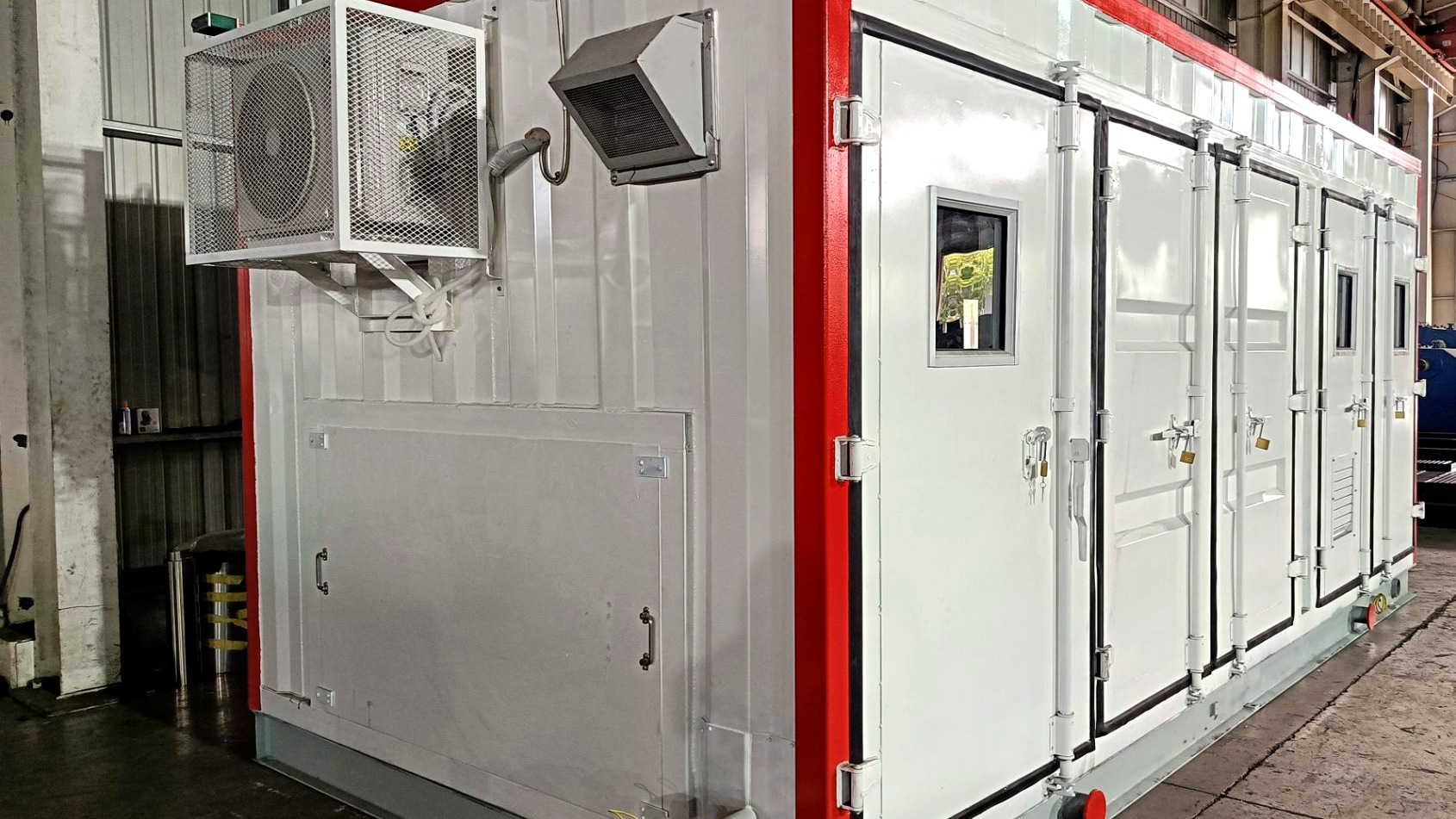
A skid is a system, not a boxed pump. What buyers should lock down on scope, interfaces and future capacity before signing.
A recent article in Pumps & Systems, *Designing Packaged Pressure Boosting Systems for Long-Term Flexibility*, makes an argument worth borrowing: a packaged boosting system should be designed not for its day-one duty point, but for decades of changing demand*1. The article's context is building-services pressure boosting, not oilfield water injection — and we keep the distinction explicit throughout this piece. But the design logic travels. It maps almost one-to-one onto a question buyers of water injection equipment keep asking: what exactly am I buying when I order a skid-mounted injection pump package, and what should the purchase documents fix before signature?
What follows is our own reading, applied to oilfield waterflood. It is a procurement-oriented framework, not a specification — numbers belong to your reservoir, your water analysis and your pump maker.
Why Waterflood Station Expansion Ends Up as a Full Replacement
The traditional answer to future growth is to oversize: buy one large pump rated for the late-life injection rate, and accept that early years run easy. The Pumps & Systems authors point out what oversizing costs in their own industry — equipment that runs far below its design point starts and stops frequently, consumes more energy per unit delivered, and wears faster than its duty suggests*1.
Waterflood adds its own reasons why oversizing fails. Injection demand is not a line you draw once: well patterns convert, producers become injectors, rates are rebalanced as the reservoir responds, and water quality or pressure requirements change with the reservoir management plan. A pump selected for the year-ten rate may spend years drifting far from any efficient operating region, and every station revision re-opens the sizing question from scratch. When the pump can no longer fit, the remedy is often a full replacement — a new power end, a new fluid end, new controls, new piping — for a station whose civil works have barely aged.
The alternative, borrowed from the packaged-systems industry, is to treat the package as expandable infrastructure: modular capacity that can grow by adding units and controls rather than by replacing the machine*1. That idea only works if the purchase documents made it possible. Which brings us to what "skid-mounted" should actually mean.
The Four Variables That Define a Package
First, a distinction buyers should make explicit. Water injection pumps are supplied in two forms: as a bare pump — power end and fluid end, driven by a motor or engine supplied and integrated by others — or as a skid-mounted package, where the pump, drive, controls, piping and base (optionally a protective house) are engineered and delivered as one unit. Neither is better. The difference is where your battery limits sit: how much of the system one supplier is responsible for, and how much integration work remains for the EPC or the operator.
Within the package form, four variables define what you actually receive:
1. Pump end and fluid end. Most high-pressure injection packages are built around a reciprocating positive displacement pump designed to API Standard 674*2. The fluid end — plunger diameters, valve configuration, materials — is selected against the injected water: its pressure, its chemistry, its solids. This variable decides what the pump survives.
2. Drive and speed control. Electric motor with a variable-frequency drive, or fixed speed with hydraulic capacity control — each combination changes the package's operating window. How a reciprocating pump should be slowed down, and where its low-load boundary sits, is pump-design-specific and must be defined with the manufacturer; a VFD catalog page is not an answer by itself.
3. Control system. Local protective functions (suction pressure, discharge pressure, temperatures), sequencing, and the interface to the station's own control layer. Whether the package "thinks for itself" or merely obeys is a scope decision that should be written down.
4. Piping, skid and layout. Suction and discharge manifolds, pulsation control, valves and instrumentation, the skid frame itself, and — depending on climate and zoning — the protective house. This variable decides how the package connects to the station: mechanically, hydraulically and physically.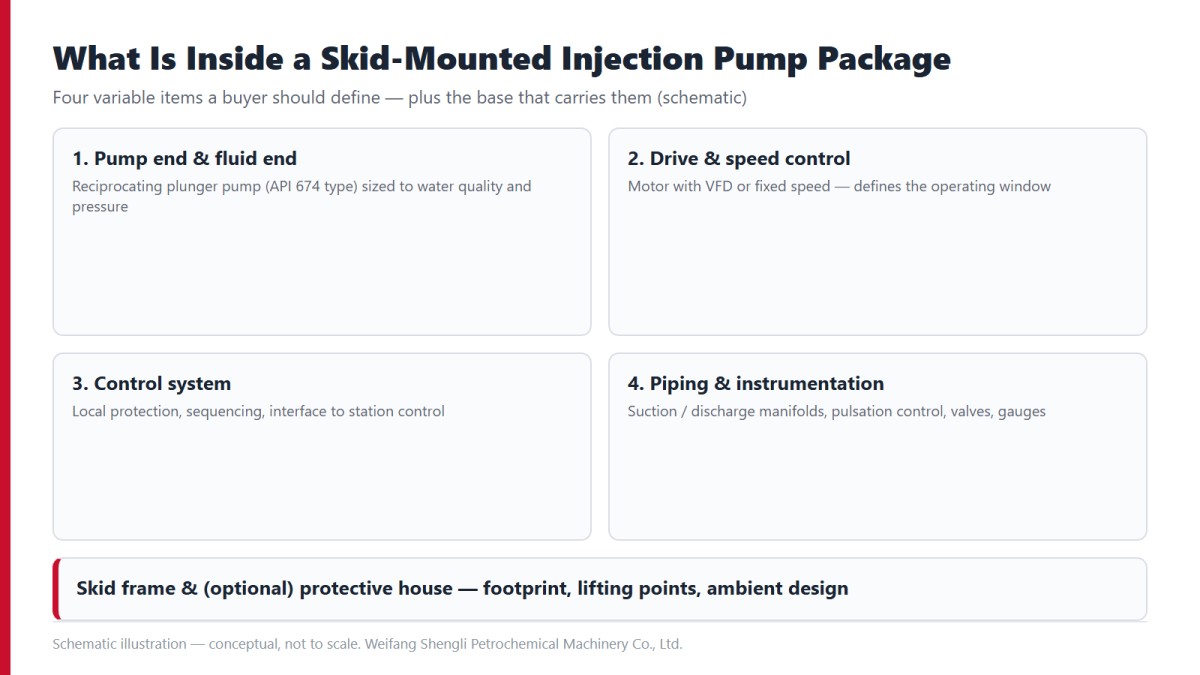
Multiple Pumps and Alternation: Spreading the Running Hours
The packaged-systems answer to variable demand is not one big machine but several smaller ones in parallel, with lead-lag control and automatic pump alternation*1. Running hours are spread evenly across the fleet; a unit can be taken out for maintenance while the others carry the load; and capacity grows by adding a pump module rather than replacing the whole train.
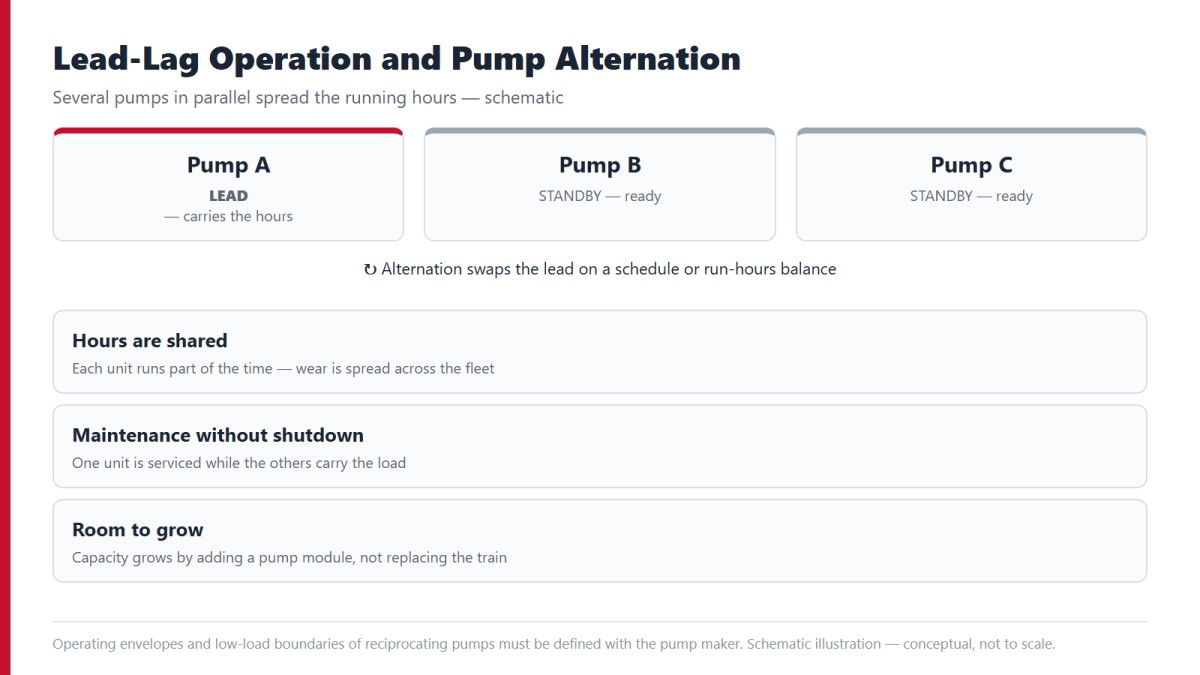
For waterflood stations the same logic applies, with one caveat we consider important: load sharing and low-load operation of reciprocating pumps are governed by the pump's design, and the acceptable operating envelope must be defined with the supplier rather than assumed. What the buyer can and should fix in the documents is the architecture: how many pumps, whether duty/standby or partial-load operation, how alternation is triggered, and what happens when one unit trips.
Control and Remote Reporting: What the Package Should Deliver
"Remote monitoring" appears in nearly every quotation. What matters is what the package can actually report, and to whom. As a capability checklist, a modern injection pump package should be able to deliver at least these categories to the station control layer:
· process values — suction pressure, discharge pressure, flow, temperatures;
· machine values — lubrication status and drive-end health indicators agreed with the supplier;
· counters — running hours, starts, duty history per unit;
· events and alarms — protective trips with time stamps, in a list format the station SCADA can consume;
· an agreed communication protocol and signal list, documented before FAT rather than negotiated on site.
Whether these points are exposed locally, to a station DCS, or onward to a remote operations centre is a purchase decision, not a technical accident. Buyers who specify the categories, the protocol and the signal list in the tender receive packages that integrate; buyers who write "remote monitoring required" receive whatever the vendor had on the shelf.
Eight Interfaces to Fix in the Tender
The purchase document is where a package succeeds or fails. Below is our working checklist — a procurement template drawn from industry practice, not a description of any specific supply — of the eight interfaces we consider essential to write down before signature.
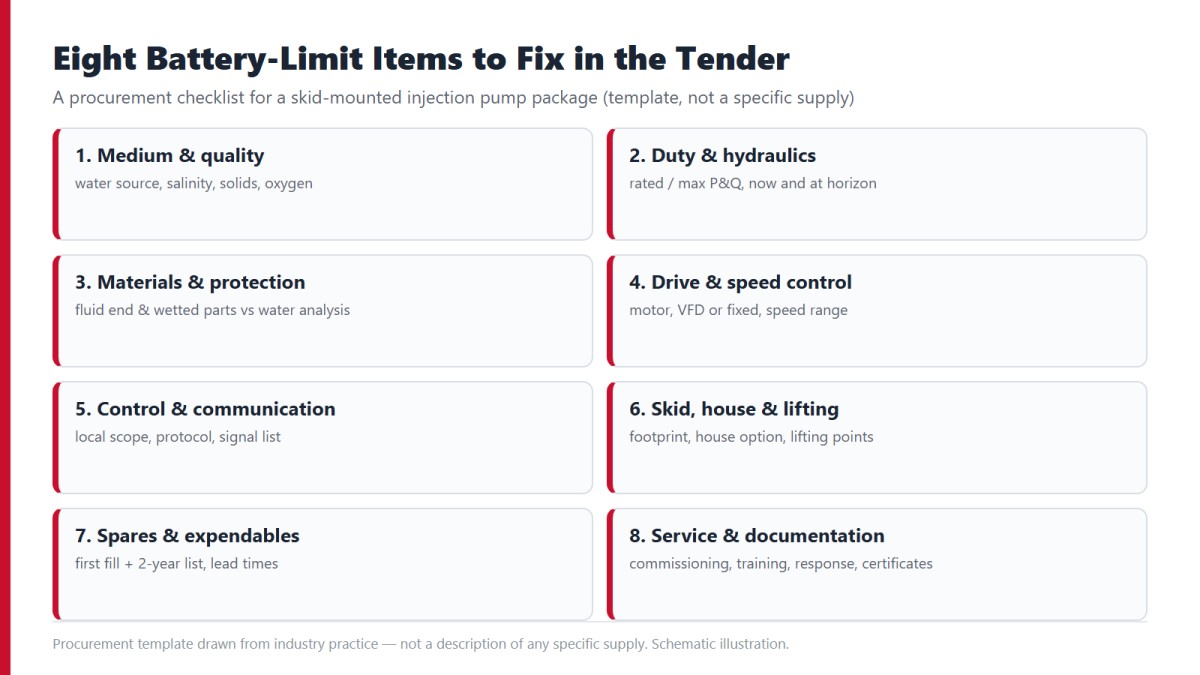
Items 1–4 decide whether the pump fits the field. Items 5–8 decide whether the package fits the station — and whether it can still fit in year five. For a package built around an API 674-type reciprocating pump, Chinese industry practice for injection pump units is additionally framed by SY/T 5183*4, which buyers operating under Chinese standards should reference alongside API 674*2 and, for controlled-volume metering duties, API 675*3.
Weifang Shengli Petrochemical Machinery Co., Ltd. manufactures high-pressure reciprocating pumps for water injection and supplies them both as bare pumps and as skid-mounted packages, with control and remote-monitoring options defined together with the buyer.
FAQ
Skid-mounted package or bare pump — how do we choose?
By where your integration capability sits. If the EPC has its own drive, control and piping engineering, a bare pump keeps the scope lean. If the operator wants a single responsible party from suction flange to control interface, a package shifts the integration risk to the manufacturer — which is usually worth paying for on unmanned or remote stations.
Does station expansion always mean replacing the pump?
No. If capacity was designed as modules — several pumps with room and interfaces reserved — expansion is an engineering order, not a civil works project. That is exactly why items 6 and 8 in the table above matter more than they first appear.
What does "battery limits" mean in a pump package contract?
It is the boundary between what the package supplier delivers and what the site provides: supply connection, suction and discharge interfaces, drain points, power supply, and who is responsible on each side of each line. Every "site surprise" in commissioning is usually an unwritten battery limit.
References
*1 Pumps & Systems. Designing Packaged Pressure Boosting Systems for Long-Term Flexibility. Derrick Oberdorf, Derrik West (Franklin Electric). 4 November 2026. https://www.pumpsandsystems.com/article/designing-packaged-pressure-boosting-systems-for-long-term-flexibility/
*2 API Standard 674, Reciprocating Positive Displacement Pumps, 3rd edition. American Petroleum Institute. https://www.api.org/products-list/api-products/
*3 API Standard 675, Controlled-Volume Positive-Displacement Pumps, 3rd edition. American Petroleum Institute. https://www.api.org/products-list/api-products/
*4 SY/T 5183, 注水泵机组(油田注水泵机组行业标准). 国家能源局发布。