


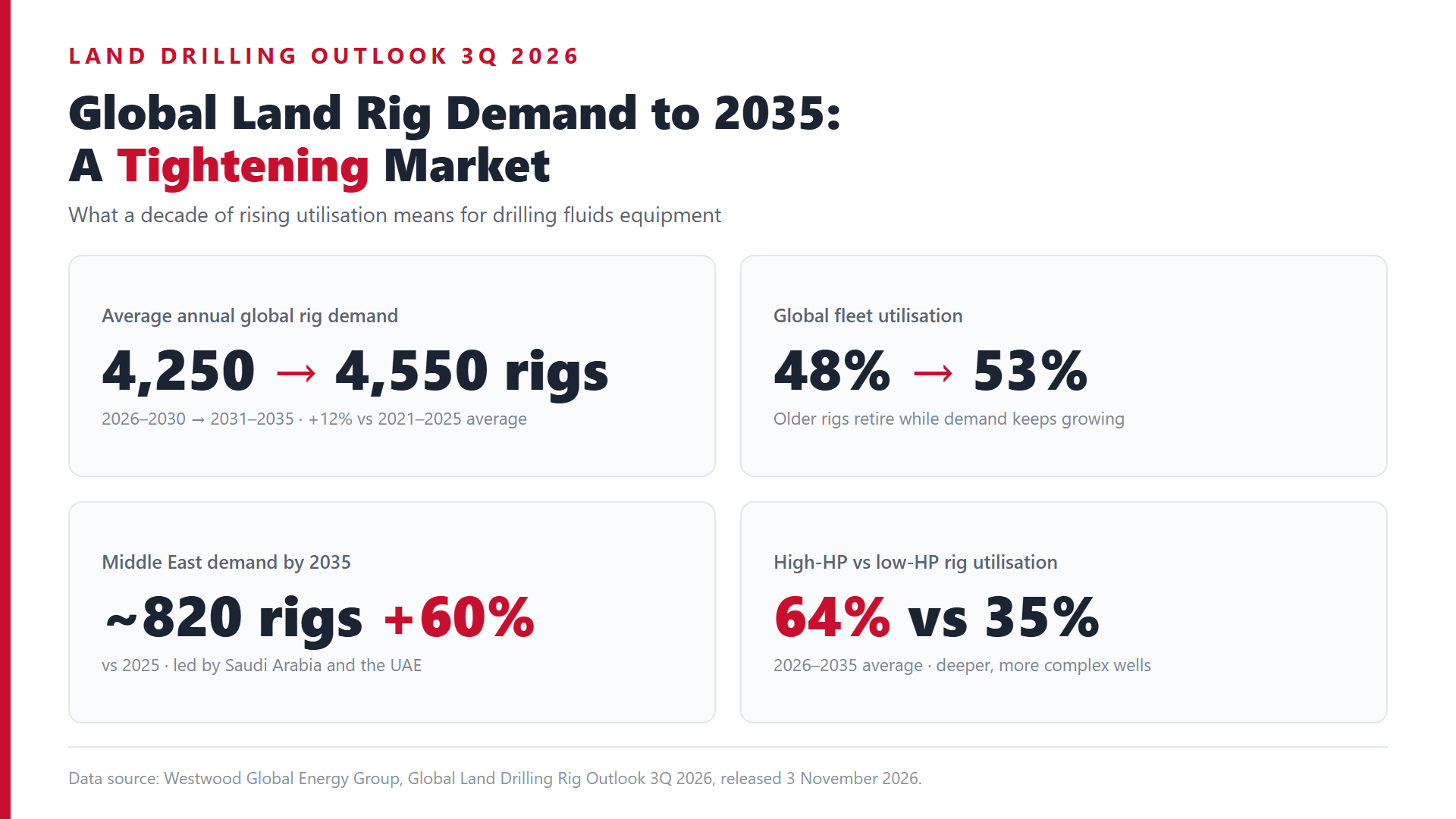
Global land drilling is entering a tightening cycle. According to Westwood Global Energy Group's *Global Land Drilling Rig Outlook 3Q 2026*, average annual rig demand will rise from roughly 4,250 units in 2026–2030 to nearly 4,550 in 2031–2035 — 12% above the 2021–2025 average — while the supply of rigs shrinks as older units retire*1. For anyone who builds or buys drilling fluids equipment, the more important number is how that demand is structured, not how many rigs it adds up to.
Westwood's 3Q 2026 Outlook: Demand Up, Fleet Shrinking
The report, Westwood's first quarterly edition and its first with a ten-year forecast, pairs rising demand with a contracting fleet. As older rigs retire, global utilisation is forecast to climb from an average of 48% in 2026–2030 to 53% in 2031–2035*1.
Source: Westwood Global Land Drilling Rig Outlook 3Q 2026, as released 3 November 2026*1. Figures are the research firm's forecast, not our own estimates.
Middle East Rig Demand: A 60% Climb Led by Gas
The Middle East is forecast to reach about 820 rigs by 2035, a 60% increase on 2025 levels. Westwood expects drilling to recover from 2027 after 2026's disruption — the firm's research manager Ben Wilby noted that this year's regional conflict hit activity hard, particularly in Iraq — led by Saudi Arabia and a UAE freed from OPEC quota constraints*1.
The drivers are structural. The UAE is targeting 5 million barrels per day of crude capacity, and ADNOC's push for gas self-sufficiency and LNG exports is deepening drilling programmes into unconventional and sour gas reservoirs*3. In an interview with Zawya, Wilby added that the Middle East's high-specification rig fleet could grow about 16% from 2025 levels by 2030 and 22% by 2035, and that NOC in-country-value policies will shape how international contractors enter — often through local joint ventures such as the SANAD programme, which is building 50 high-horsepower rigs in Saudi Arabia*3.
What Does This Mean for Mud Pump Specification?
This is where we move from the report's facts to equipment logic — our own reading of what a tighter, deeper, higher-utilisation market asks of mud pumps.
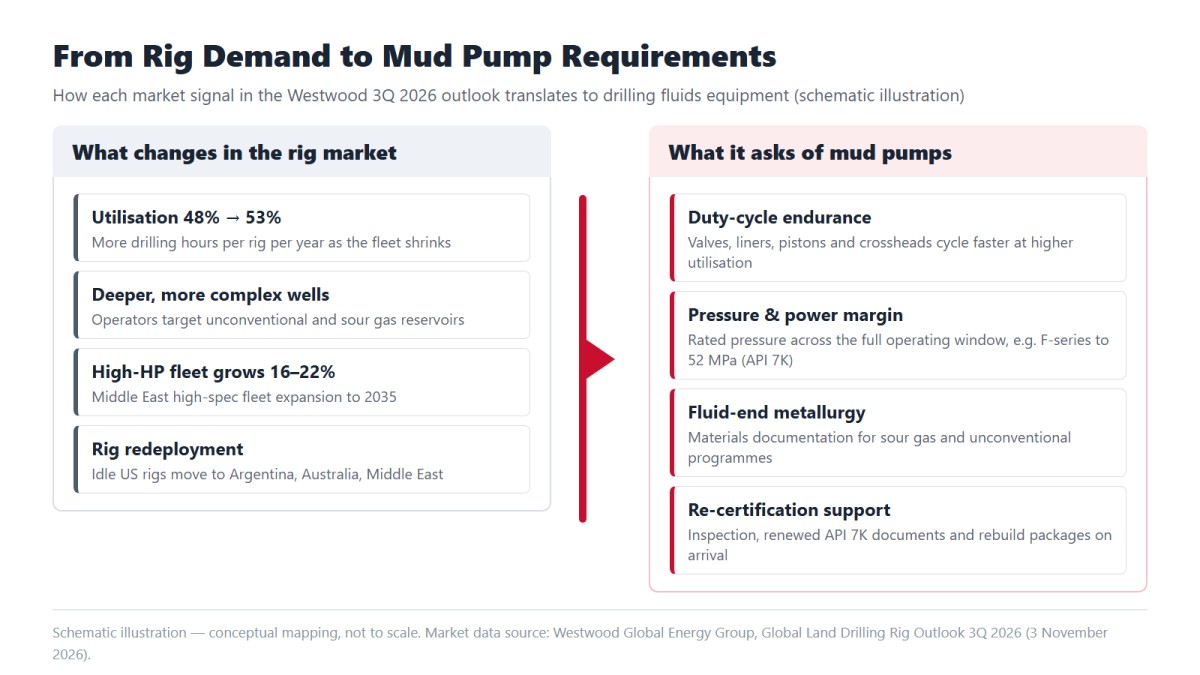
Figure 1. From rig demand to mud pump requirements — conceptual mapping, not to scale. Data source: Westwood Global Energy Group, Global Land Drilling Rig Outlook 3Q 2026 (3 November 2026).
ALT: Schematic mapping four rig-market changes to four mud pump requirements.
1. Pressure and power margin move up the selection criteria. Deeper and more complex wells mean longer pump hours at higher standpipe pressures. On the rig floor this translates into a simple question for procurement: does the fluid end hold its rated pressure across the whole operating window, not just on test stands? Our F-series mud pumps (F1300 through F2200HL) are rated to a maximum working pressure of 52 MPa (7,542 psi) with power up to 1,600 kW (2,200 hp) and flow up to 279.38 m³/h (1,237 gpm), and are manufactured under API Spec 7K*4. High-line-pressure variants (HL) exist precisely for this kind of market.
2. Utilisation turns wear parts into a lifecycle question. A rig running 53% utilisation drills far more metres per year than one running 48%. Valves and seats, liners, pistons and crosshead components cycle proportionally faster. Westwood's own distinction between 64% utilisation for high-horsepower rigs and 35% for low-horsepower units*1 is, from a pump seat, a forecast of where fluid-end consumption will concentrate.
3. Redeployment means re-certification. Westwood expects under-utilised US rigs to be redeployed to Argentina, Australia and the Middle East*1. A rig that has crossed an ocean does not re-enter service as-is: pressure-containing parts, safety devices and certificates all need inspection and renewal against API 7K*4. That creates work for pump rebuilders and parts suppliers on both ends of the journey.
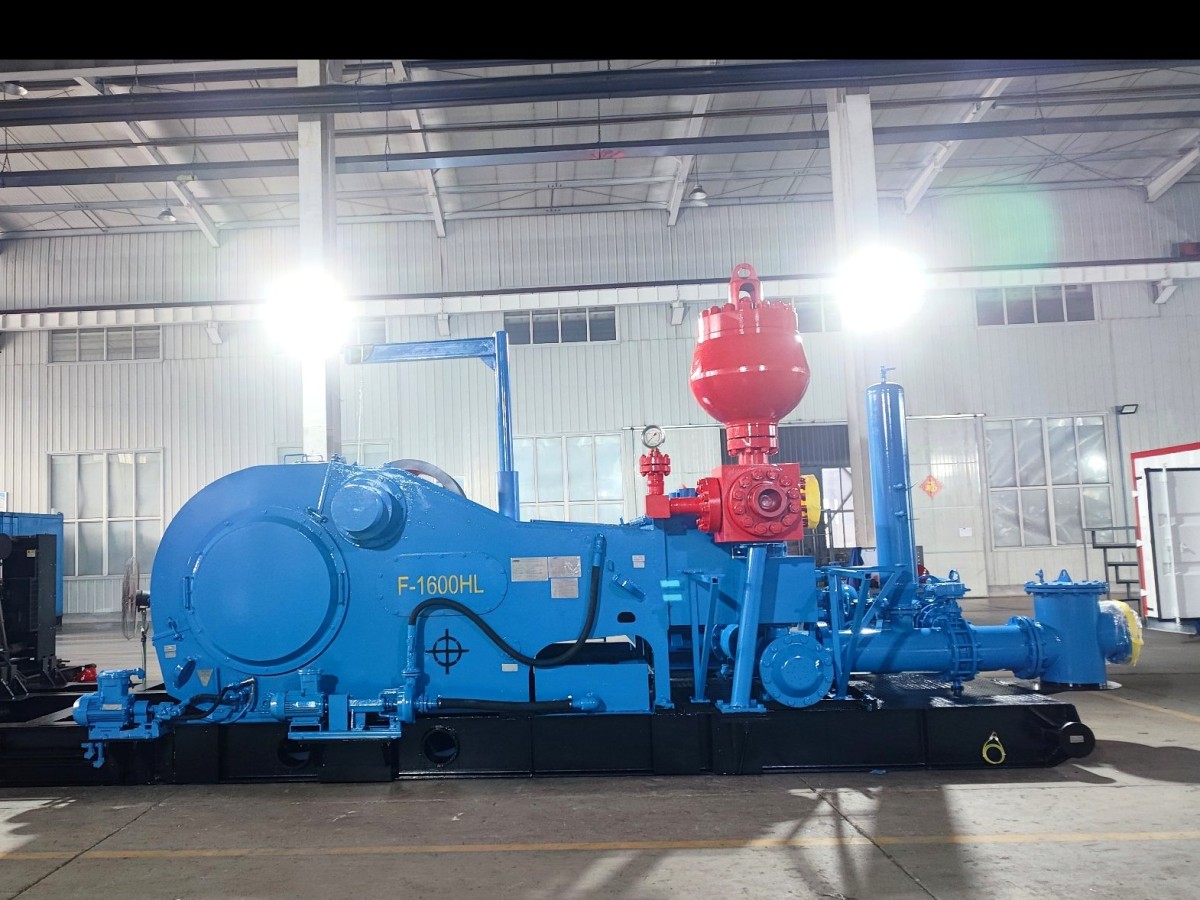
Figure 2. F-1600HL mud pump (F-series, F1300–F2200HL). Product photo taken in our workshop — not a project site.
ALT: Blue F-1600HL mud pump on its skid in the assembly workshop.
Parts and Re-Certification: The Quieter Growth Story
A +60% regional demand headline suggests new rigs. The utilisation data suggests something more incremental: much of the incremental activity will run through existing and redeployed fleets before it becomes new-build tonnage. Zawya's reporting points the same way — idle Middle East rigs are relatively few, so reactivations and redeployments will carry part of the load, and dayrates are expected to rise as availability tightens*3. For equipment suppliers, that places spare parts availability, fluid-end rebuild capability and regional service response alongside new-unit sales in the opportunity set.
We state this as analysis, not fact: one consultancy's forecast is a planning input, not a certainty. Commodity prices, regional security and operator budgets can shift the path significantly — Westwood itself conditions the Middle East recovery on security stabilising and reliable export routes*2.
How Mud Pump Suppliers Should Respond
Three practical moves follow from the data, offered as industry observations rather than commitments:
1. Specify for the well, not the average. Quote pressure ratings across the full temperature and duty cycle, and document fluid-end metallurgy — sour gas and unconventional programmes in the Gulf will interrogate it.
2. Build the parts business before the unit business. Forecast valve, liner and piston consumption by rig class; make lead times and packaging export-ready.
3. Treat re-certification as a product. Inspection packages, renewed API 7K documentation and refurbishment turnkey support are what a redeployed rig needs on arrival*4.
FAQ
Will the Middle East really add 60% more rigs by 2035?
It is a forecast, not a guarantee. Westwood's scenario assumes recovery from 2027 led by Saudi Arabia and the UAE, and explicitly conditions it on regional security and export reliability*1*2.
Which mud pump ratings matter most for deep wells?
Continuous working pressure and duty-cycle endurance outrank peak nameplate figures. Our F-series is rated to 52 MPa maximum working pressure under API Spec 7K*4; matching pump model to well programme should be done case by case with the drilling contractor.
References
*1 Westwood Global Energy Group. Global land drilling rig market set to tighten as Middle East demand rises 60% by 2035, Westwood forecasts. London, 3 November 2026. https://www.westwoodenergy.com/news/global-land-drilling-rig-market-set-to-tighten-as-middle-east-demand-rises-60-by-2035-westwood-forecasts
*2 World Oil. Global land rig market to tighten as Middle East, Latin America drive demand, Westwood says. 3 November 2026. https://www.worldoil.com/news/2026/11/3/global-land-rig-market-to-tighten-as-middle-east-latin-america-drive-demand-westwood-says/
*3 Zawya Projects. Middle East land drilling rig demand forecast to rise 60% by 2035: Westwood. 4 November 2026. https://www.zawya.com/en/projects/oil-gas/middle-east-land-drilling-rig-demand-forecast-to-rise-60-by-2035-westwood-2011744
*4 API. API Spec 7K, Specification for Drilling and Well Servicing Equipment. American Petroleum Institute. https://www.api.org/