


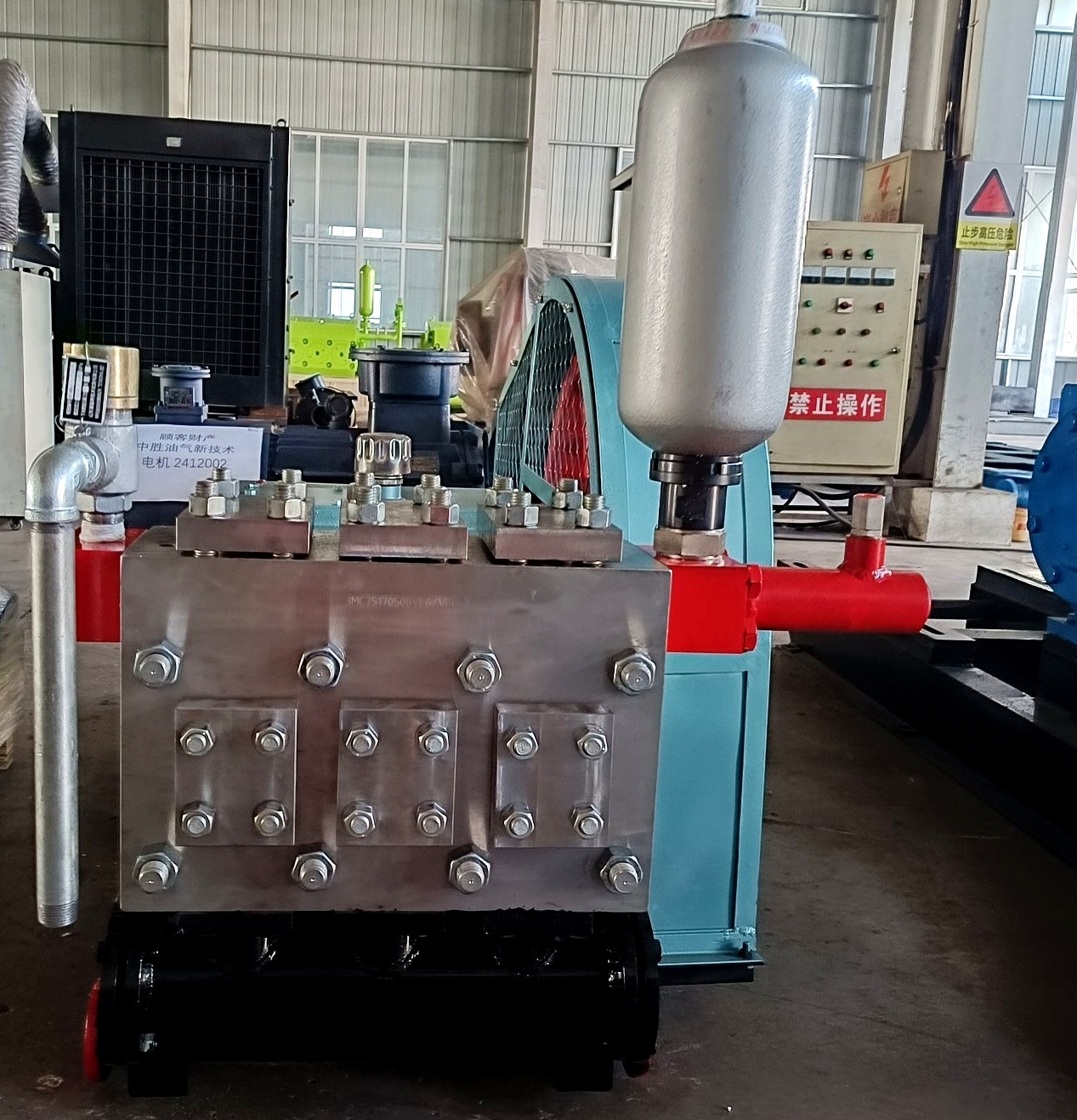
*Rated discharge pressure describes a boundary. Operability is decided at the suction flange — by phase state, subcooling margin, heat input and stream chemistry.*
Most CO₂ injection pump enquiries begin with maximum discharge pressure. It decides less than almost any other line in the specification, and a pump that can contain its rated pressure is not yet a pump that injects stably.
CO₂ Injection: Pump or Compressor? Decide by Suction Phase
CO₂ reaches its critical point at 31.0 °C and 73.8 bar. Below it, pressure alone liquefies the fluid: at 20 °C the saturation pressure is about 57.3 bar and the saturated liquid density about 773 kg/m³.
A stream at 20 °C and 60 bar is therefore already liquid, and lifting it to injection pressure is a pumping duty — a small volumetric compression of an almost incompressible fluid, repeated at high frequency. Compressor duty begins when the inlet is gas and the job is to cross the phase envelope.
*Fact: the phase boundaries of pure CO₂ are fixed by thermodynamics. Opinion: specify the pump backwards from the inlet condition, not forwards from the rating.*
CO₂ Pump Subcooling: Why NPSH in Metres Is Not Enough
Liquid CO₂ at 20 °C exists only because something holds it at 57 bar. A few bar lost across a strainer or a half-open valve is enough for it to boil, and a reciprocating pump will not absorb that: fixed displacement means gas in the chamber stops delivery and runs the packing dry.
So NPSH in metres is the wrong unit. Specify the subcooling margin at the pump flange, in bar or kelvin, against the saturation pressure at the coldest point of the suction system, then design around it: a short large-bore suction line, a low-loss strainer with differential pressure monitoring, static head or a booster, and an interlock that trips rather than warns.
CO₂ Pump Cavitation: Why Heat Input Beats Pressure Rating
At 1.5 MW shaft input and 95 % mechanical efficiency, about 75 kW ends up in the fluid. For 20 m³/h of liquid CO₂ — 4.3 kg/s, specific heat near 5 kJ/(kg·K) — the rise per pass is about 3.5 K. Between 20 °C and 30 °C saturation pressure climbs about 1.5 bar per kelvin, so 3.5 K lifts it by about 5 bar. If the suction margin was 5 bar, the fluid reaching the packing is already boiling: the pump cavitates at 60 bar while its rating is untouched.
Near the critical point the figures shift — at 30 °C, density about 598 kg/m³ and specific heat about 36 kJ/(kg·K) — so the temperature rise shrinks while density becomes steeply variable. The remedies stay mechanical: low internal losses, insulation, a minimum-flow bypass with a cooler, and temperature measured at the suction flange as well as the discharge.
CO₂ Pump Materials: Dry Gas Is Not the Corrosion Risk
Dry CO₂ does not attack carbon steel; free water in CO₂ does. Dissolved CO₂ forms carbonic acid, and measured rates under saturated conditions reach tens of millimetres per year — a failure mode, not a maintenance interval. Dehydration is the primary corrosion control.
ISO 27913:2024 treats stream quality as a system property: one specification agreed between capture, transport and storage, dense phase defined by density, dehydration in the order of 50 ppm gaseous and 100 ppm dense, and no aqueous phase at any point.
The mechanical response is conservative: forged stainless pump heads, uncoated solid internals, ceramic plungers, and packing with a secondary seal so leakage is detected rather than hidden. A −50 °C rating is a materials question, not a thermostat setting.
CO₂ Pump Specification: 5 Inputs Before You Ask for a Price
Pulsation belongs in the specification too: API 674 treats it as a design requirement, because a pressure wave that is harmless in water can cross the phase boundary in CO₂. Five inputs decide the rest — inlet pressure and temperature, subcooling margin, discharge pressure and turndown, composition and water content, and the standard and documentation level.
Frequently asked questions
Do I need a compressor or a pump for CO₂ injection?
Decide from the state at the inlet flange. Liquid or dense at suction plus a pressure rise means a plunger pump; gas at suction crossing the phase envelope means compressor work.
Why does a CO₂ pump cavitate below its rated pressure?
The rating constrains the fluid end, not the suction margin. Fluid held near saturation loses pressure in the suction line and gains heat inside the pump.
Specifying a Dense-Phase CO₂ Injection Pump?
Weifang Shengli Petrochemical Machinery manufactures liquid and dense-phase CO₂ pumps, high-pressure reciprocating plunger pumps, and pump heads and seal components. Send the inlet conditions, flow, discharge pressure and stream composition; we will tell you which number is currently the limiting one.