


As the global energy industry accelerates its transition toward high efficiency and sustainability, Artificial Intelligence (AI) has rapidly transformed from a traditional "supplementary tool" into a core engine driving upstream oil and gas development. Recently, the Springer Nature open-access journal Discover Artificial Intelligence published a comprehensive review titled "A systematic and critical review of artificial intelligence applications for enhancing well stimulation operations and sustainable reservoir management"
Combining our company’s deep technical expertise in oilfield wellbore equipment with these cutting-edge AI trends, we explore how this technological revolution will reshape the future of high-pressure pumps and fracturing equipment.
I. Core Technology Insights: The Four Major Battlegrounds of AI in Well Stimulation
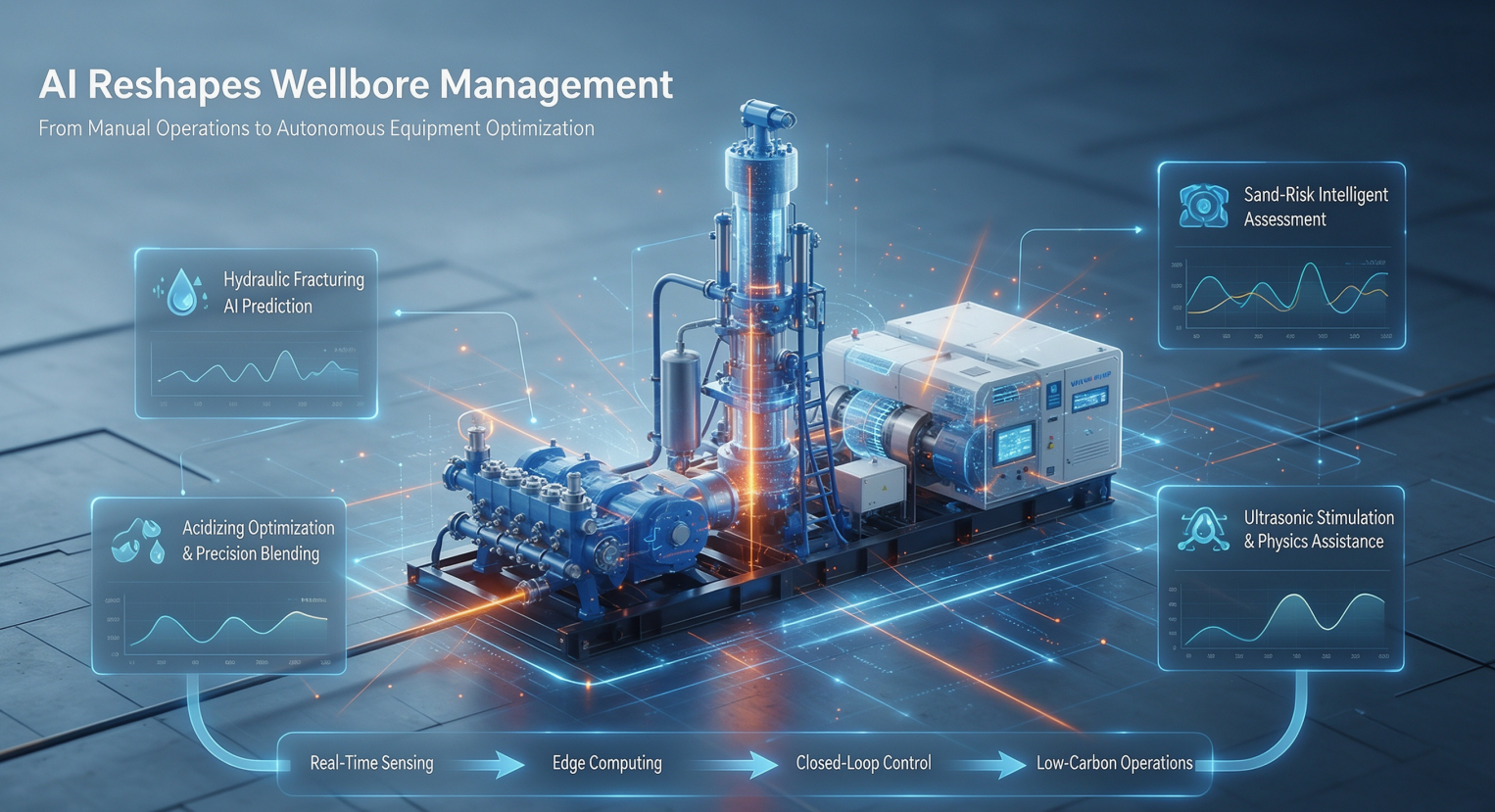
According to the quantitative synthesis and classification research of the review, AI applications in oilfield stimulation primarily concentrate on four technological directions
Hydraulic Fracturing:
Technical Breakthroughs: Tree-based models (such as Random Forest, XGBoost), deep learning (CNN/LSTM), and reinforcement learning (RL) are widely applied in fracture geometry prediction, real-time anomaly detection, and adaptive pumping control
. Industry Impact: Modern intelligent fracturing systems enable real-time operational optimization, effectively reducing non-productive time and minimizing water and chemical waste
.
Acidizing & Acid Fracturing:
Technical Breakthroughs: Neural networks and gradient boosting trees have shown exceptional performance in predicting pore volume to breakthrough (PVBT) time and acid-fracture conductivity, with $R^2$ values consistently ranging between 0.82 and 0.96
. Industry Impact: AI enables precise screening of acid blends and additives, substantially lowering the risks of precipitation or sludge formation
.
Sand Control:
Technical Breakthroughs: By integrating well logs, geomechanics, and distributed optical fiber (DAS/DTS) data, machine learning-based sanding risk prediction achieves an accuracy exceeding 90%, significantly enhancing completion design reliability
.
Ultrasonic Stimulation & Emerging Technologies:
Technical Breakthroughs: As a lower-chemical or physics-assisted stimulation method, ultrasound demonstrates immense potential in mitigating near-wellbore damage and reducing asphaltene precipitation. Coupled with Physics-Informed Neural Networks (PINNs), AI is progressively stepping into the optimization modeling of acoustic frequencies and power
.
II. Strategic Significance and Intelligent Upgrade Prospects for Win-Win Pump
As a specialized enterprise focusing on oilfield wellbore equipment, Win-Win Pump (
1. Intelligent Monitoring and Feedback Centered on Real-Time Sensing
Future high-pressure pump groups and fracturing equipment will no longer operate as isolated mechanical power sources; instead, they will serve as critical nodes in the Industrial Internet of Things (IIoT). By integrating vibration, pressure, and temperature sensors, equipment can capture operational parameters in real time and leverage edge computing to identify air locks, overpressure, erosion, or fluid anomalies within milliseconds
. 2. Adaptive Control and Closed-Loop Operation
Powered by reinforcement learning and adaptive control algorithms highlighted in the literature, pumping systems can automatically adjust discharge rates and power output based on downhole real-time pressure and fiber-optic monitoring data, bridging the gap from "manual scheduled adjustments" to "autonomous equipment optimization"
. 3. Supporting Low-Carbon Operation and ESG Compliance
Under corporate "dual-carbon" objectives, AI-driven precise fluid and chemical ratio matching reduces unnecessary energy loss and chemical over-dosing. Our intelligent high-pressure pump solutions will place greater emphasis on life-cycle energy efficiency optimization, helping oilfield clients achieve green, low-carbon, and sustainable extraction goals
.
III. Conclusion
The comprehensive penetration of artificial intelligence into well stimulation marks a rapid transition of the petroleum industry toward a high-quality development stage defined by digitization, intelligence, and sustainability. Win-Win Pump will closely track global technological frontiers, continuously advance the integration and innovation of digital intelligence with high-end equipment manufacturing, and deliver pump solutions featuring intelligent perception, adaptive control, high efficiency, and low carbon to build a smarter oilfield future together with global partners!