


The value of an award letter tells you what one contractor won. The contract structure tells you how the region will buy for the next decade.
In the first week of November 2026, Abu Dhabi's onshore oil and gas sector produced two announcements days apart. On 2 November, at ADIPEC, ADNOC confirmed a final investment decision for the Ruwais Diyab unconventional gas development — its first large-scale unconventional gas project, designed to deliver 345 million standard cubic feet per day of raw gas from 2029 over a 25-year period*2. On 4 November, the Chinese listed engineering contractor Jereh disclosed three award letters from ADNOC Onshore for onshore surface-facility packages worth about US$2.70 billion combined*1.
For pump manufacturers, the headline figures matter less than the structures behind them: one package is delivered under a design-build-operate (DBO) model, two as multi-year call-off frameworks. Both change where risk sits, how long the buyer relationship lasts, and what a supplier must prove before an order arrives.
What the Three ADNOC Onshore Award Letters Say
The award letters disclosed on 4 November 2026 cover three packages on ADNOC Onshore's fields in Abu Dhabi:
Three cautions belong next to this table. These values are one contractor's awards, not total Middle East investment. None of the three is a signed contract: formal agreements must be finalized within 90 days of each LOA start date*1. Injection rates, pressures and fluid chemistry are not published — the scope is a demand signal, not a specification. ADNOC's own release confirms the DBO structure was chosen "to reduce development risk"*2.
The DBO Shift: From Selling Equipment to Sharing Sixty Months of Operation
Under a DBO structure, the contractor does not hand over a facility at mechanical completion. It builds the plant, then operates and maintains it for sixty months — with options to extend by up to two five-year terms*1, keeping the contractor and its supply chain inside the same facility for close to fifteen years.
The stated reason is risk reduction: builder and operator are the same party, so design errors and procurement shortcuts land on one balance sheet. When the builder also operates, purchase price stops being the deciding variable — uptime, maintainability, spare-parts availability and documentation quality move to the centre, because unplanned downtime during the operating term is now the contractor's cost. On a DBO project, the pump that wins is the pump whose reliability records and lifecycle documentation a contractor is willing to carry for fifteen years.
Call-Off Frameworks: Volume Is Conditional, Readiness Is Not
The two field packages at Bab/North East Bab and Bu Hasa use a different instrument: no fixed plant design, but task orders issued in batches as field development proceeds — survey, supplementary design, procurement, construction and commissioning support per order*1. The Bab/NEB framework starts on 11 November 2026 and runs sixty months; Bu Hasa runs thirty-six with an optional twenty-four-month extension.
The intent is speed: the programs are labelled "One Tie-In" — a standing capability to connect new wells on short cycle, with much of the equipment — wellhead module skids, gas lift skids, control panels — fabricated as packaged units.
For suppliers, volume is conditional: a US$599.7 million framework over sixty months guarantees no order in any given quarter. The route in runs through the EPC contractor's procurement chain, so vendor approval, API-standard documentation and reference projects must be in place before the first task order is written.
What Do Water Injection, Disposal and WAG Wells Mean for Pump Suppliers?
The most relevant line for pump manufacturers sits inside the Bab/NEB scope: the framework explicitly covers supporting construction for water supply wells, water injection wells, disposal/reinjection wells and water-alternating-gas (WAG) injection wells*1. Whatever the final well count, the operator is programming a sustained injection campaign across a sixty-month horizon.
The service classes involved are distinct:
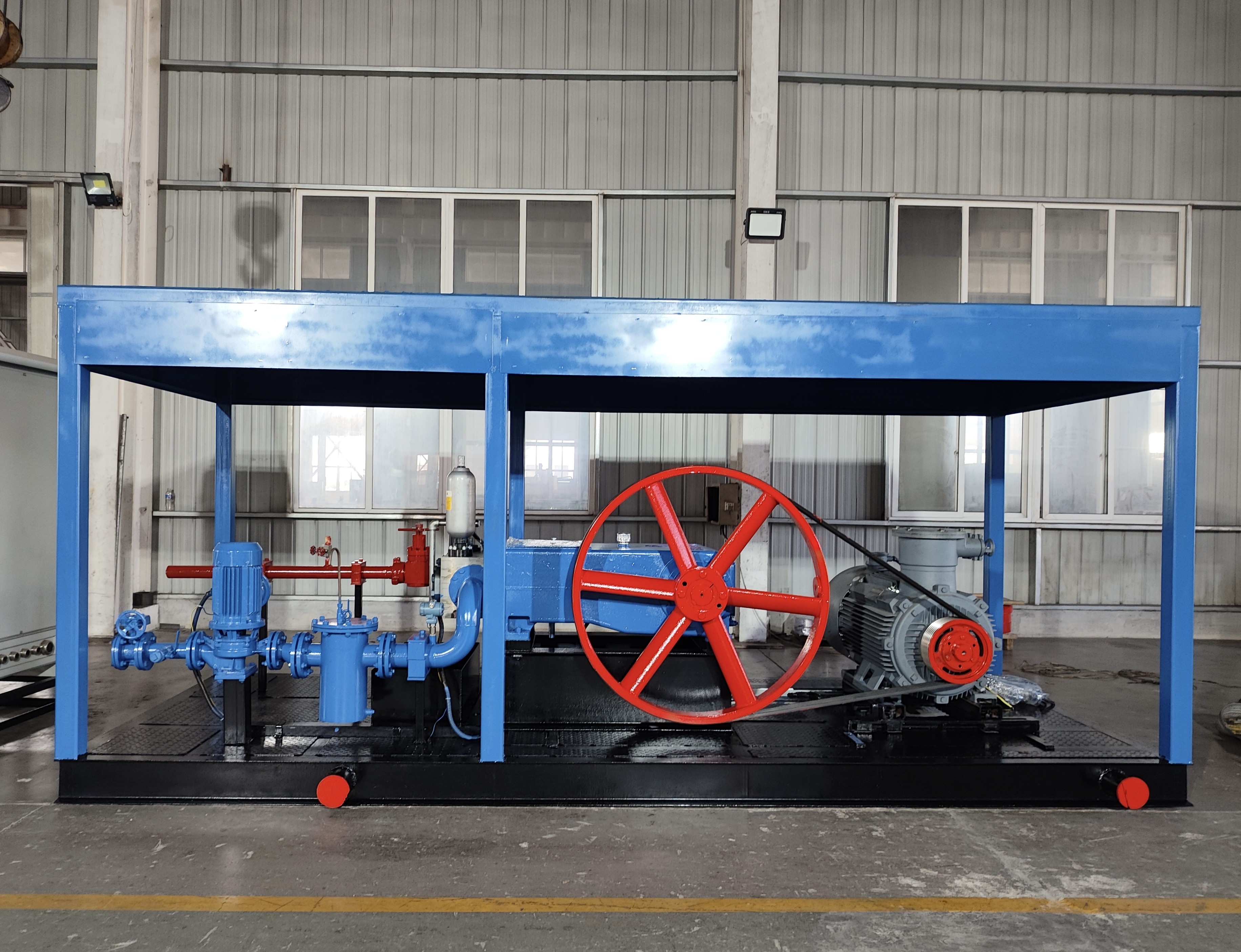
· Water injection is continuous, high-pressure duty, where fluid chemistry drives material selection — the classic territory of API 674 reciprocating plunger pumps and ISO 13710 service*6,*7.
· Disposal/reinjection handles produced water, adding abrasive and scaling considerations to the same duty.
· WAG injection alternates slugs of water and gas — frequently CO₂ or hydrocarbon gas — to improve sweep efficiency*8. A WAG scheme therefore needs both legs on the surface side: high-pressure water injection pumps and gas/CO₂ injection capability, specified separately, because each leg has its own suction condition and duty cycle.
One caveat repeats: injection rates, pressures and water chemistry are not published. What the letters establish is that injection-related construction is programmed inside a sixty-month framework on one of the world's largest onshore operating areas — a demand signal with a timeline, not a purchase order.
Independent Context: One Project Is Not a Trend
The procurement shift above should not be inferred from three award letters alone. Rystad Energy reports more than US$100 billion of Middle East upstream investment in 2025 and expects roughly 10% growth, to about US$110 billion, in 2026 as megaprojects move into execution*3. S&P Global projects GCC NOC capital expenditure of US$115–125 billion per year across 2025–2027, more than half of it upstream*4. The IEA sees Middle East investment roughly flat in 2026 while the UAE and Saudi Arabia retain or accelerate long-term programs, including ADNOC's commitment to award US$55 billion of contracts over three years*5. Spending is concentrating in long-cycle, execution-heavy projects — precisely the conditions under which DBO and call-off structures become the preferred procurement instruments.
What Equipment Suppliers Should Do Now
1. Qualify through EPC supply chains — under DBO and call-off models the pump buyer is usually the contractor; vendor registration and audit records must be ready for contractor procurement systems.
2. Document compliance before it is asked for — API 674 design files, ISO 13710 references, factory performance tests and data books shorten qualification inside the 90-day finalization window.
3. Price for fifteen years, not for delivery — DBO moves lifecycle cost into the purchase decision; spare-parts plans and service coverage belong in the base offer.
4. Cover both legs of injection — high-pressure plunger pumps and gas/CO₂ injection packages are separately specified units; one supplier covering both shortens the contractor's supply chain.
What is a call-off contract in oilfield surface facilities?
A call-off contract is a framework agreement under which the buyer issues individual task orders as work becomes necessary, instead of awarding one fixed-scope project. The framework fixes unit rates, qualifications and response obligations for a multi-year term; actual volume depends on how many orders the operator releases.
What is WAG (water-alternating-gas) injection?
WAG injection is an improved-recovery method that alternates water slugs and gas slugs — commonly CO₂ or hydrocarbon gas — into a reservoir, combining the mobility control of waterflooding with the displacement efficiency of gas injection. For surface facilities it requires both water injection pumping and gas injection capability as separate systems.
References
*1 Jereh Group (002353.SZ). Announcement on Award Letters Received by Its Wholly-Owned Subsidiary (No. 2026-075), 4 November 2026; published in Securities Times / China Securities Journal, 5 November 2026. https://epaper.stcn.com/con/202611/05/content_2993329.html (full text: http://epaper.zqrb.cn/html/2026-11/05/content_1286030.htm?div=-1)
*2 ADNOC. ADNOC Takes FID on Ruwais Diyab Unconventional Gas Development. Abu Dhabi, 2 November 2026. https://www.adnoc.ae/en/media-center/news/2026/11/ADNOC-Takes-FID-on-Ruwais-Diyab-Unconventional-Gas-Development
*3 Rystad Energy (Aditya Saraswat), via Oil & Gas Middle East. Middle East cements role as global energy stabiliser. https://www.oilandgasmiddleeast.com/news/mena-energy-outlook
*4 S&P Global. 2026 GCC Energy Outlook: Capex, Capacity and Integration, January 2026.
*5 International Energy Agency. World Energy Investment 2026. Paris, June 2026. https://www.iea.org/reports/world-energy-investment-2026
*6 API Standard 674, Positive Displacement Pumps—Reciprocating, 3rd edition, December 2010. American Petroleum Institute.
*7 ISO 13710:2004, Petroleum, petrochemical and natural gas industries — Reciprocating positive displacement pumps. ISO.
*8 Christensen, J.R., Stenby, E.H., Skauge, A. Review of WAG Field Experience. SPE Reprint Series, 2001 (paper SPE 71203).