


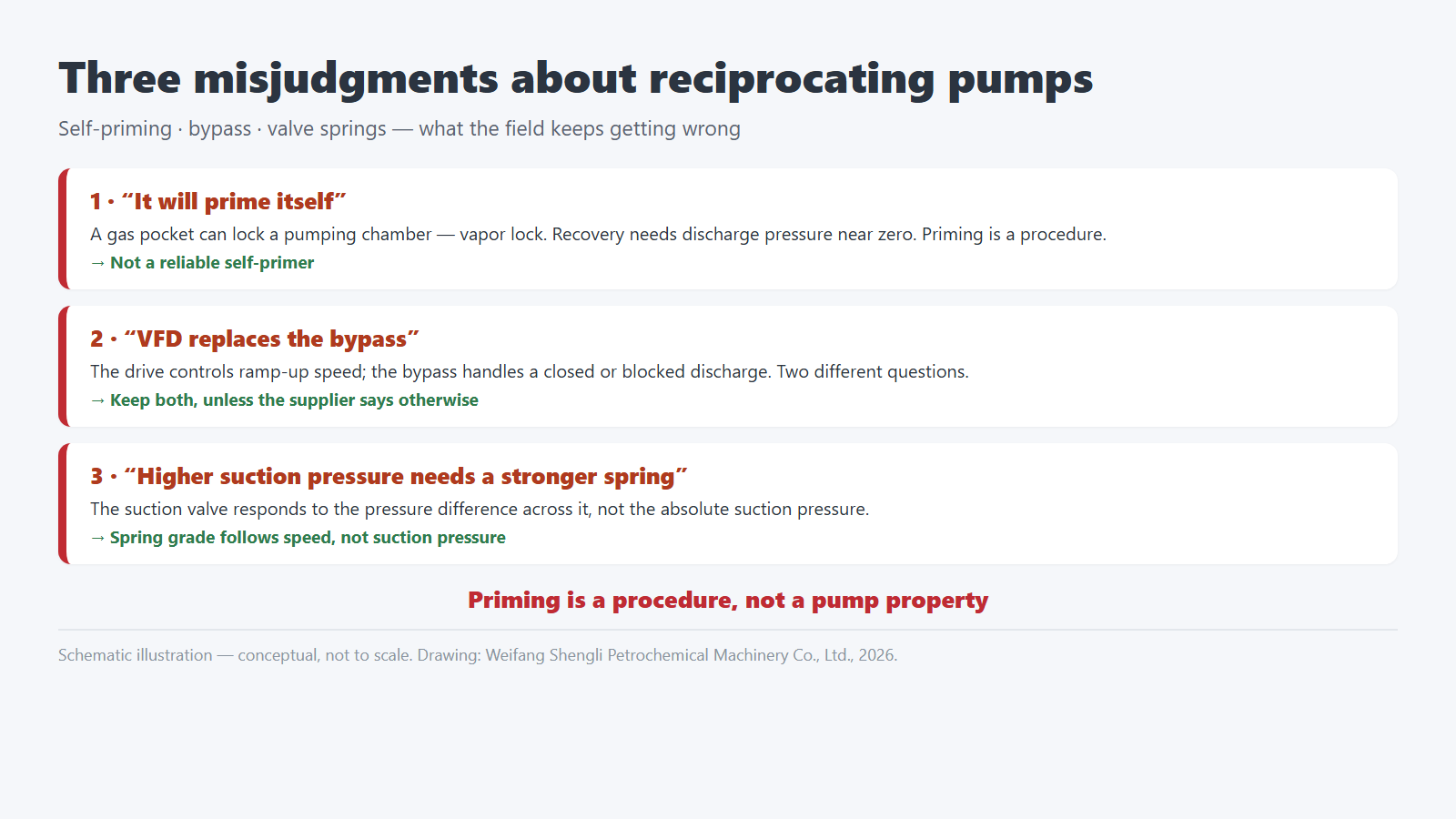
Not a broken pump and not always the suction line — three recurring misjudgments, and the operating rules that follow.
What "self-priming" actually means for a power pump
A power pump — a reciprocating pump driven through a crankshaft — displaces a fixed volume on every stroke, and that is exactly why the assumption "it will prime itself" keeps coming back. It is one of the most persistent misjudgments in the field: a power pump is not a reliable self-primer.*1
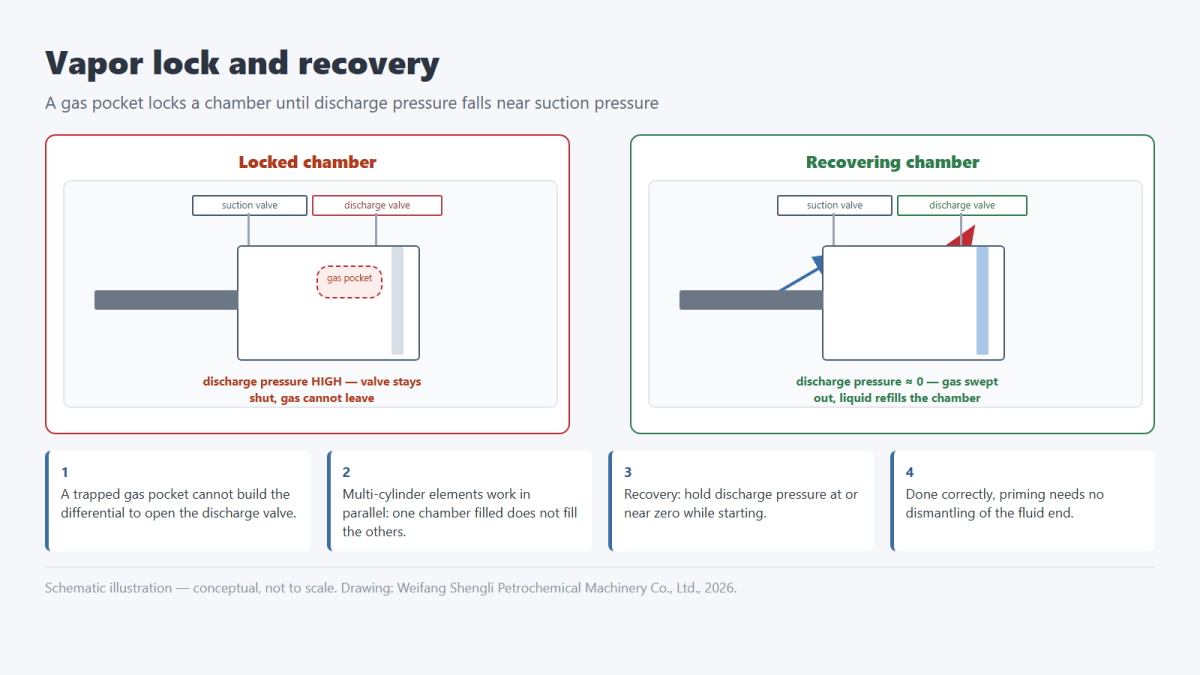
The mechanism is simple. If a pocket of gas is trapped in a pumping chamber, that chamber cannot build up the pressure differential needed to open the discharge valve. The chamber is locked by its own gas — what pump people call vapor lock — while the other chambers keep working. To recover, the discharge pressure has to fall to near the suction pressure so the gas can be swept out of the chamber and liquid can take its place.*1
Multi-cylinder designs add a second trap: the pumping elements work in parallel. One chamber filled with liquid does not fill the others, so "half the pump is pumping" can coexist with a chamber still gas-locked.*1
The practical conclusion is that priming is a procedure, not a hope. Done correctly — with the discharge pressure held at or near zero while the pump is started — most pumps can be primed without opening the fluid end or pre-filling every chamber by hand.*1 That single rule prevents more field confusion than any other in this article.
Startup and the bypass: two different questions
The second misjudgment sounds modern: "we have a variable-frequency drive now, so the pump ramps up slowly — the bypass line can go."
A drive and a bypass answer different questions. The drive controls how fast the pump reaches speed. The bypass answers what happens when the discharge has nowhere to go: a closed discharge valve at startup, a blocked line, a dead-headed segment. A power pump running even at low speed can raise pressure very quickly against a closed valve, and the events that put a pump into that situation are not events the drive was asked to control.*1
The bypass also connects back to priming. Recovery from a gas lock requires the discharge pressure to fall to near suction pressure; a properly arranged bypass is one of the practical ways to get there without dismantling anything.*1
Whether a given pump and system requires a bypass — and how it should be sized and routed — depends on the pump design and the service, and is confirmed with the pump supplier case by case. The point here is narrower: deleting the bypass because a drive exists is not a design decision; it is a category mistake.
Valves, springs and speed: what actually closes the valve
A third cluster of misjudgments sits around the valves.
The first: "the valve is closed by backflow." In a well-designed pump it is not. The valve spring moves the valve toward its seat near the end of the stroke so it lands gently; reverse flow only finishes what the spring started. As speed rises, the spring must be stronger — otherwise the valve is slammed onto its seat by the backflow, and the slam is heard as vibration in the pump and the piping.*1
The second: "higher suction pressure needs a stronger suction-valve spring." The opposite of intuition, and false: the suction valve responds to the difference between suction pressure and chamber pressure, not to their absolute level.*1
The third concerns speed and NPSH. The cited reference gives experience values, not standard clauses: near rated speed, roughly 10 psi of NPSH is typically required; at speeds below roughly 200 rpm, the suction-valve springs can be removed and the required NPSH drops to about 1 psi. Valve maximum lift, in the same source, is governed by crankshaft speed — not by valve size.*1
These numbers belong to one author's published experience with power pumps. They are useful as order-of-magnitude guidance and as questions to ask, not as substitute for the pump's own data sheet.
Packing and plunger surface: the real variables of packing life
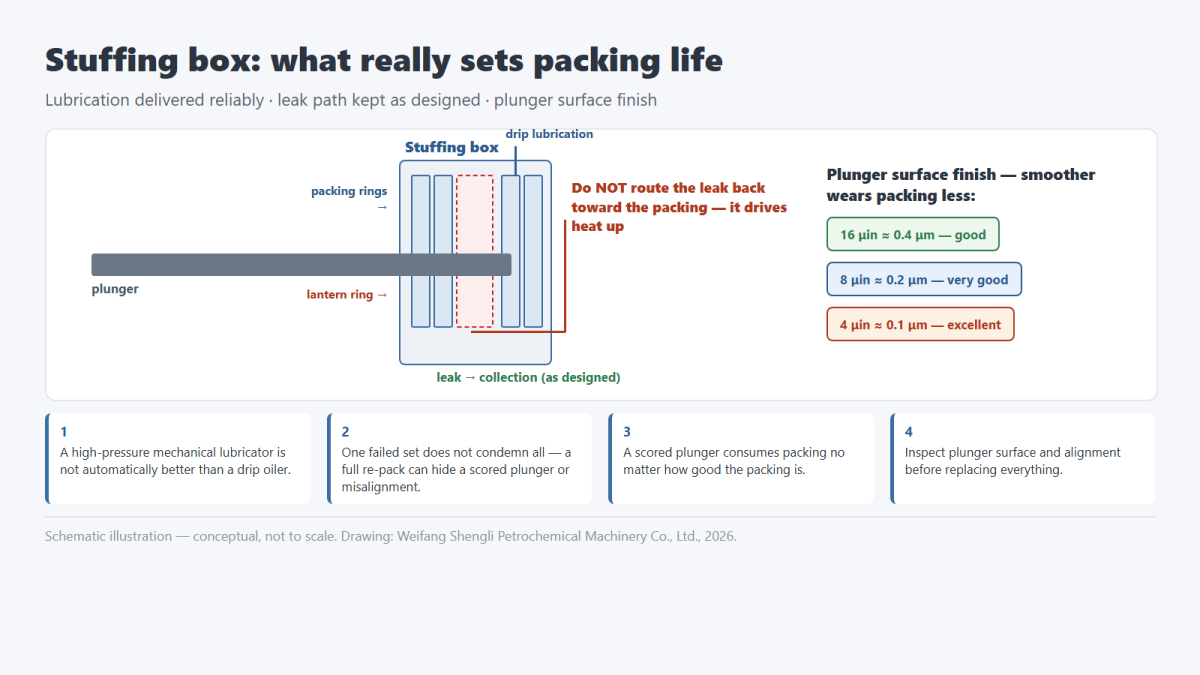
Packing life is another area where habit substitutes for analysis. Four points from the same source are worth carrying into any maintenance conversation.*1
Lubrication. A high-pressure mechanical lubricator is not automatically better than a simple atmospheric drip oiler. What packing needs is the right amount of lubrication, delivered reliably — not the most sophisticated hardware.
The lantern ring. Using the lantern ring as a leak-return point — routing leaked liquid back toward the packing — can substantially increase heat generation in the stuffing box. The leak path has a function; repurposing it changes the thermal balance of the packing.
Replace selectively. One failed set of packing does not automatically condemn all of them. Repacking every chamber at once can quietly mask an individual misaligned stuffing box or a scored plunger — the cause of the failure stays in the pump and repeats. Find the cause before the full re-pack.
Surface finish. A smoother plunger surface wears packing less. The cited experience values: 16 μin (≈0.4 μm) is good, 8 μin (≈0.2 μm) is very good, 4 μin (≈0.1 μm) is excellent. The trend matters more than any single number: a scored plunger will consume packing no matter how good the packing is.
Field quick-reference: symptom, cause, first check
What to confirm with the supplier
The five misjudgments above translate into a short list of questions worth asking before an order, and re-asking after any duty change:
1. Startup and priming procedure — the written procedure, including whether discharge pressure must be held near zero and how long dry priming may run.
2. Bypass requirement — whether the pump/system design requires one, its sizing basis, and its role in the priming sequence.
3. Valve spring grades — which grades are fitted, and what happens if the speed range changes.
4. Stuffing box arrangement — lubrication options, lantern ring function, allowed leak rate and collection.
5. Plunger surface specification — finish class, hardening, and the inspection criterion that separates "reusable" from "repack only".
None of these items is exotic. All of them are cheaper to ask about than to learn from a gas-locked startup or a third packing failure.
FAQ
Q1. Can a reciprocating (power) pump self-prime?
A: Not reliably. A gas pocket trapped in a pumping chamber can lock it — the chamber cannot build differential pressure until the discharge pressure falls to near suction pressure and the gas is swept out. Priming is a procedure, not a pump property.*1
Q2. If the pump has a variable-frequency drive, can the bypass line be deleted?
A: No. The drive controls ramp-up speed; the bypass handles the situation where the discharge has nowhere to go, and it supports the near-zero discharge pressure needed during priming. Whether and how to fit one is confirmed with the pump supplier.*1
Q3. Does higher suction pressure require a stronger suction-valve spring?
A: No. The valve responds to the difference between suction pressure and chamber pressure, not to the absolute suction pressure.*1
Q4. When one packing set fails, should all sets be replaced?
A: Not automatically. A complete re-pack can mask a misaligned stuffing box or a scored plunger. Inspect alignment and plunger surface first, then replace selectively.*1
Superscript *n marks the numbered sources cited in the text. Entries are given in their original language; numbering is identical across the Chinese, English and Russian versions.
*1 Terry Henshaw, Power Pump Myths, Pumps & Systems, published 2013-08-28. https://www.pumpsandsystems.com/article/power-pump-myths/ — the numerical values cited (NPSH, speed, surface finish) are the author's published experience values, not standard clauses.
*2 API Standard 674, Positive Displacement Pumps—Reciprocating. Cited as the terminology and framework reference only;
Related Posts
Online Message