


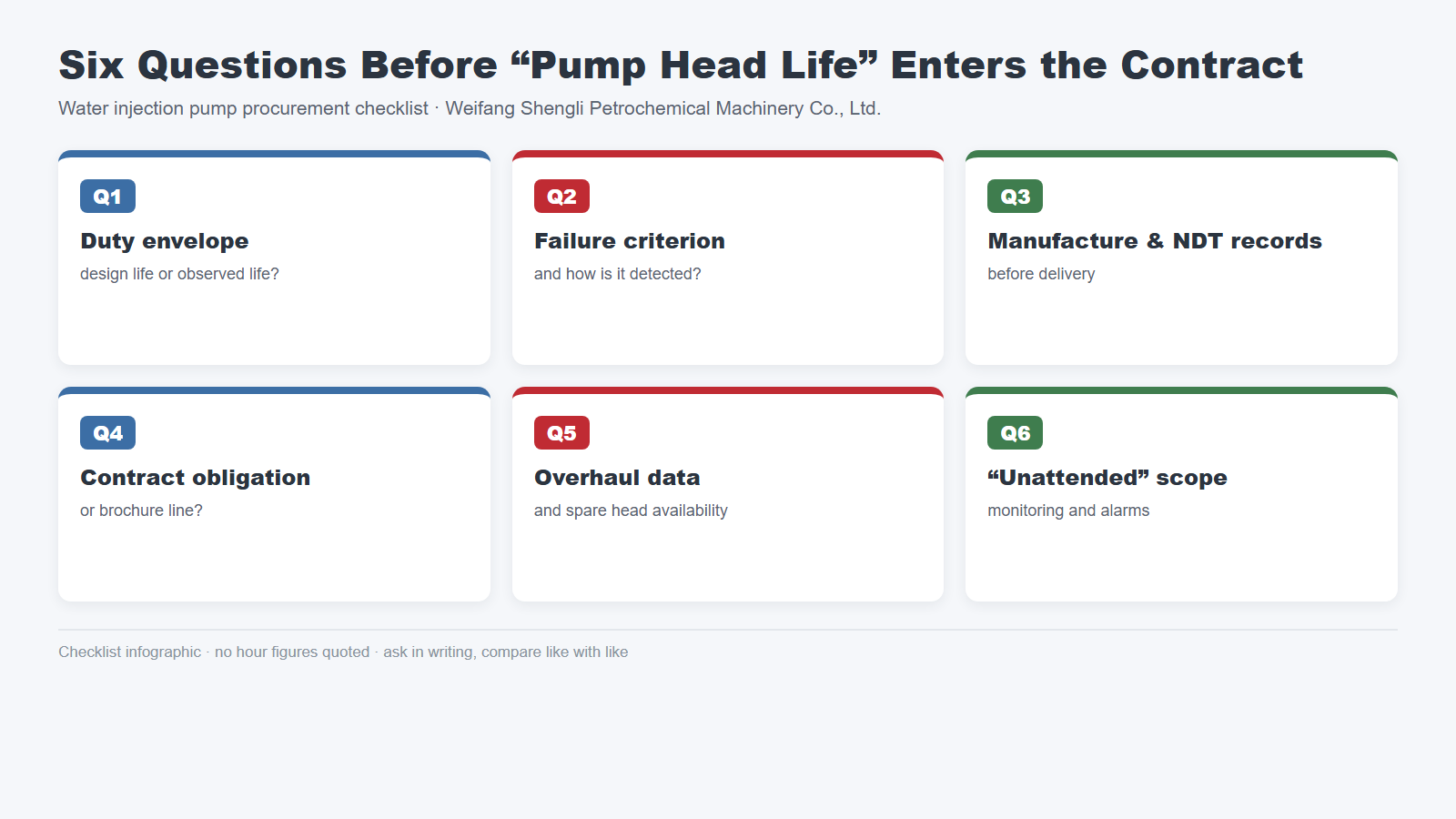
An hour figure without a duty envelope proves nothing. Six questions to ask every supplier before pump head life enters your contract.
Why pump head life is suddenly on the bid table
Water injection pumps have long been bought on three lines: pressure, flow and price. A fourth line is now appearing on evaluation sheets — how long the pump head body lasts.
A recent report in China Petrochemical News describes an electric pressure-drive water injection device developed jointly with Shengli oilfield by Sinopec Oilfield Equipment (model SYLQ800Q-105D), highlighting a long-life pump head body reported at 16,000 hours, a 95% localization rate and unattended operation.*1 Whatever one makes of a competitor's number, the fact that it is quoted at all marks a shift: the pressure-containing heart of the pump — the fluid end — is becoming a procurement topic in its own right, and suppliers are answering in hours.
That shift deserves to be taken seriously in both directions. An hour figure quoted without its conditions is marketing. A figure backed by a defined duty envelope, a failure criterion and warranty wording is engineering. The difference is not visible on a datasheet — it only shows up when someone asks. This article lists the questions worth asking.
What limits a pump head: cycles, not just hours
A pump head body does not wear out the way packing or valves do. It fails mechanically by fatigue. Every plunger stroke superimposes a pressure cycle on the metal, and over a sufficient number of cycles cracks initiate — most often at geometric discontinuities, such as the intersecting bores where valve bores and flow passages meet. Water chemistry adds a second mechanism: corrosive or scaling injection water can pit internal surfaces and shorten the path to crack initiation. Neither mechanism appears on a datasheet. (This paragraph is the authors' engineering analysis.)
Two consequences follow for procurement.
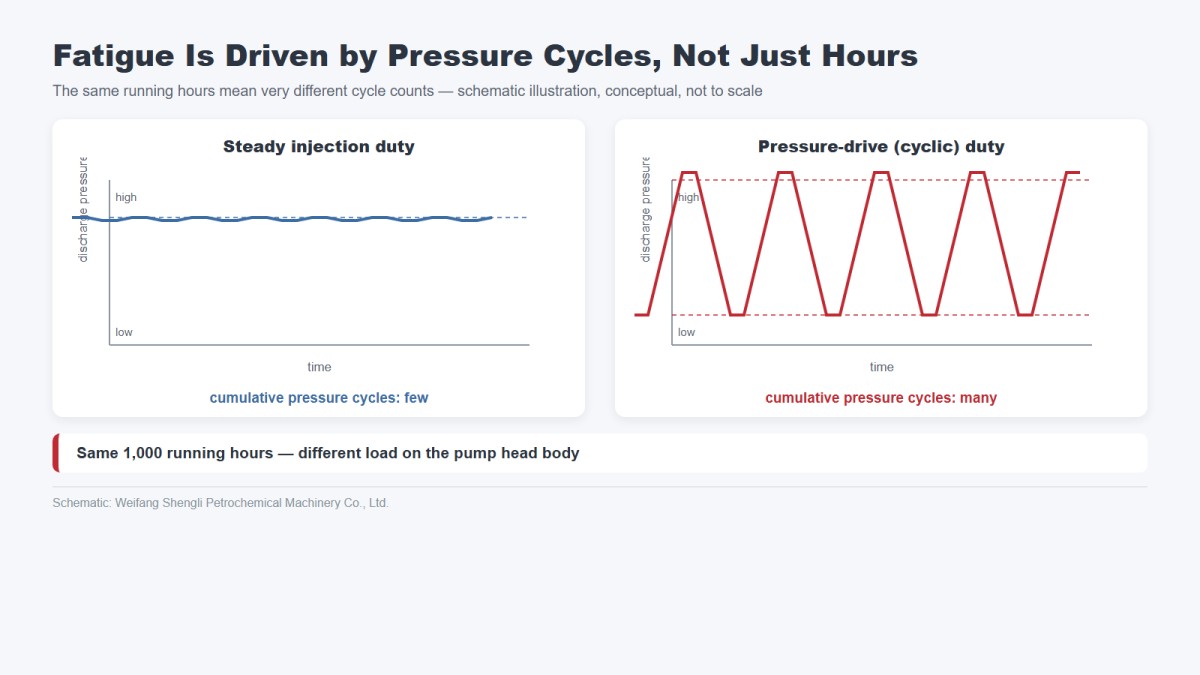
First, "hours" alone is an incomplete unit. The same running hours accumulate very different pressure cycles depending on discharge pressure, start-stop frequency, and whether the duty is steady injection or a cyclic mode — such as the pressure-drive injection referenced in the report — that repeatedly drives the pump to high pressure and releases it.*1 Fatigue counts cycles, not adjectives.
Second, the head is only one item in the life chain. Packing, plungers, valves and seals age at different rates and are replaced at different intervals. A headline figure for one pressure-containing part should not be read as the service interval for the whole pump.
The six questions
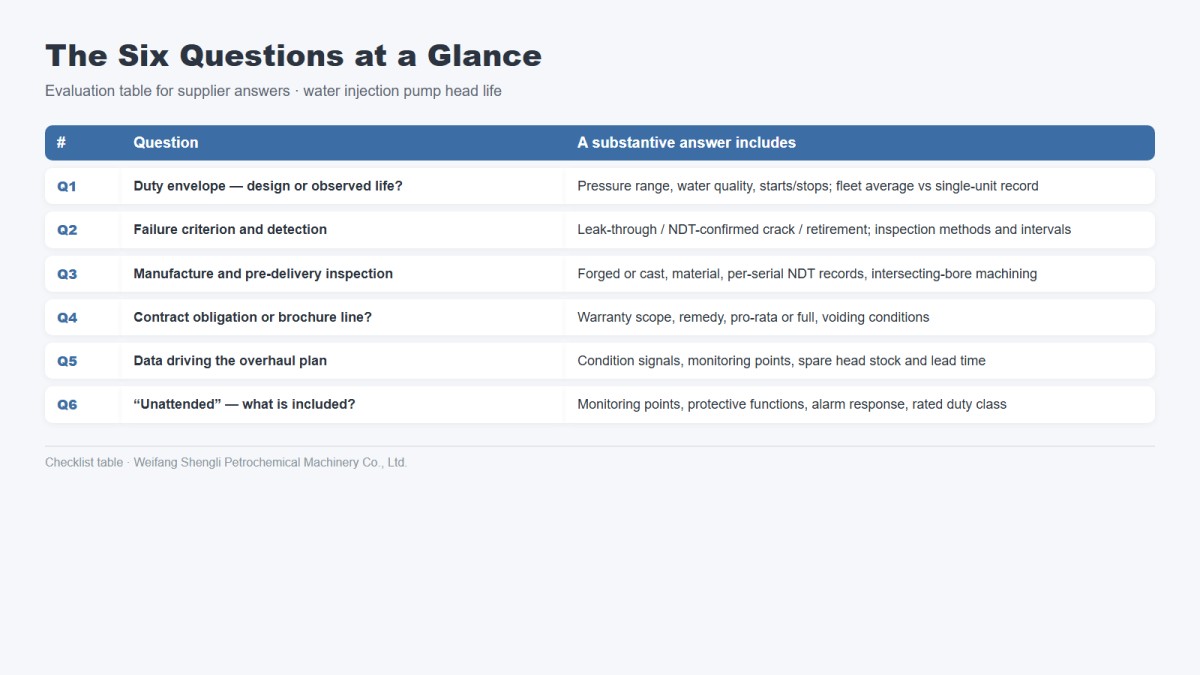
The six questions below can be put to any supplier, in writing, before a quotation is accepted. Each is followed by what a substantive answer looks like.
Q1. What duty envelope is the quoted figure tied to — and is it design life or observed life?
A credible answer states the discharge pressure range, water quality (solids, dissolved salts, corrosive species), temperature and start-stop frequency behind the number, and says whether the figure is a fleet-observed average, a single-unit record or a design calculation. A record from one unit running on favorable water is not a fleet expectation.
Q2. What is the failure criterion, and how is it detected?
"Pump head life" needs an endpoint: leak-through, a crack confirmed by non-destructive testing, or scheduled retirement? Ask which inspection methods are recommended in service — dye penetrant, ultrasonic testing, borescope examination of intersecting bores — at what intervals, and who performs them.
Q3. How is the head manufactured and inspected before delivery?
Ask whether heads are forged or cast, what material is used, and what surface and volumetric NDT records exist per serial number, including the machining quality of intersecting bores — the usual initiation sites. The useful answer is documentation, not adjectives.
Q4. Is the life figure a contract obligation or a brochure line?
A number in marketing material is not a warranty. Ask what the warranty covers — hours or months; whether the remedy is repair, replacement of the head, or replacement of the pump; whether compensation is full or pro-rata; and what voids it, such as off-spec water, overpressure events or missed maintenance. If the supplier wants the number quoted, it should survive being written into the contract.
Q5. What operating data will drive the overhaul plan?
Condition signals — packing leak rate, flow at constant speed, discharge pressure trends, valve behavior — allow condition-based overhaul planning, which tracks the actual duty rather than a generic table. Ask which monitoring points the pump offers, whether a spare pump head assembly is stocked or on call, and what the lead time is. A fixed-hours plan tuned to someone else's water can be wrong by a wide margin.
Q6. What does "unattended operation" actually include?
Ask which remote monitoring points and protective functions are included — vibration, leak detection, lubrication, pressure — and what happens on each alarm. Then check the duty match: a pump cycled hard in pressure-drive-type duty loads its fluid end differently from one running steady injection, so "unattended" should be quoted together with the duty class it was rated for, not as a standalone benefit.*1
From answers to a decision
Put the six answers from each bidder side by side and compare like with like. A life figure quoted at moderate pressure in fresh water is not comparable to one at higher pressure in high-salinity brine; the duty envelope (Q1) has to match before the numbers can be ranked. In practice, the definition of the duty and the warranty wording — Q1 and Q4 — separate engineering from marketing faster than the headline figure does.
Total cost of ownership also reads differently once the fluid end is in scope. Acquisition is one line in a pump's lifetime cost; energy and downtime dominate the rest. Downtime for worn packing is a planned maintenance window; downtime for a cracked pump head is an unplanned outage of the injection system. That asymmetry is why the fluid end has earned its own line on the evaluation sheet.
A note on our own answer
Weifang Shengli Petrochemical Machinery Co., Ltd. manufactures high-pressure reciprocating plunger pumps for water injection service, supplied as single pumps or as skidded injection pump groups — pump, driver, baseplate, manifolds, instrumentation and control on one frame, with battery limits confirmed case by case.
We do not publish a generic pump-head hour figure. In our view the honest answer depends on the duty envelope: pressure, water, cycling and temperature decide the outcome, and the right place to commit to a number is the contract, after the duty is defined — not the brochure. We would rather walk through your duty first, and answer the six questions in writing.
FAQ
Q1. Is a higher quoted pump head life always the better pump?
A: No. A number cannot be compared without its duty envelope — discharge pressure, water quality, start-stop frequency. A high figure quoted under light conditions may represent less engineering than a moderate figure quoted under severe ones.
Q2. Should the life figure be written into the contract?
A: If a supplier quotes hours, ask for it as a contractual term with a defined duty envelope, failure criterion and remedy. Otherwise the figure is marketing material, and the contract should rest on the warranty terms that actually exist.
Q3. Can pump head life be extended in service?
A: Operating within the rated envelope, controlling water quality and using condition-based monitoring all help. Fatigue is cumulative, so managing pressure cycles and detecting early signs matter more than any single measure.
Q4. What is pressure-drive injection, and why does it matter for the fluid end?
A: It is an injection mode that repeatedly drives the pump to high pressure for short periods and releases it, rather than running steady. Each cycle loads the fluid end, so cyclic duty puts more pressure cycles on the pump head per running hour. Ask the supplier to rate the head for the actual cycling profile.
Superscript *n marks the numbered sources cited in the text. Entries are given in their original language; numbering is identical across the Chinese, English and Russian versions.
*1 中国石化报(China Petrochemical News),《钻井大平台:难动用储量开发新范式》之"石化机械:让科研成果转化为降本增效良方",2026-11-17(署名罗天保);转载:中国石油石化工程信息网,2026-11-18。https://www.cppei.org.cn/zjlt/d257797.html(注:型号与 16,000 小时数字为部分核实,引用时以"reported"限定)
*2 API Standard 674, Reciprocating Positive Displacement Pumps, American Petroleum Institute(往复式正排量泵标准,本文术语框架参考,未引具体条款)
Related Posts
Online Message