


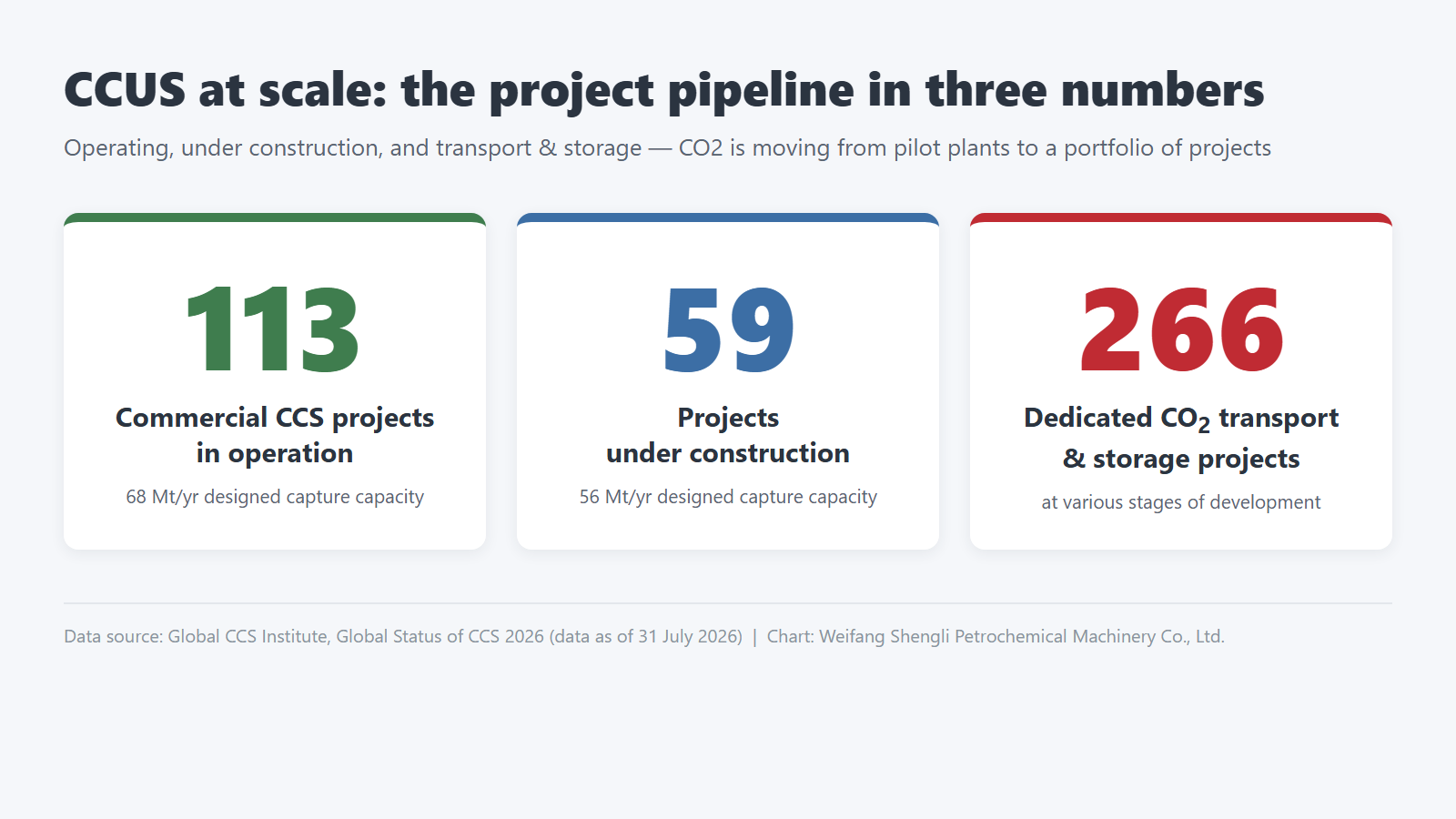
113 operating projects and 266 transport-and-storage developments are moving CO2 injection equipment from pilot scale to procurement scale.
Where CCUS stands: three numbers that define the stage
The Global CCS Institute's Global Status of CCS 2026 (data as of 31 July 2026) reduces the industry's position to three figures.*1 As of the cut-off date, 113 commercial CCS projects were in operation worldwide, holding a combined designed capture capacity of 68 million tonnes per year. A further 59 projects were under construction, designed to add 56 million tonnes per year. Separately from capture, 266 dedicated CO2 transport and storage projects sit at various stages of development.
Capture accounts for the first two figures. The third covers everything that follows — boosting, moving, injecting and monitoring the CO2 once it has been captured — and it is the largest count of the three.
Source: Global CCS Institute, Global Status of CCS 2026 (data as of 31 July 2026).
Money is tracking the projects. According to the IEA's 2026 work on financing CCUS at scale, commercial debt financing for CCUS exceeded US$15 billion over the past two years, drawn mainly from large non-recourse transactions in Europe and North America.*2 Regional studies point the same way: an Xodus assessment cited in industry coverage puts the Asia-Pacific CCUS market at up to US$252.8 billion by 2035 under an accelerated deployment scenario, and estimates that seven economies — Japan, the Republic of Korea, Chinese Taipei, Malaysia, Indonesia, Australia and New Zealand — could together export about 83 million tonnes of CO2 per year before 2030, potentially reaching nine economies and some 145 million tonnes per year by 2035.*3
China reached the million-tonne scale in October 2026, when construction began on Sinopec's million-tonne low-concentration CCUS full-chain demonstration at the Shengli oilfield. The project draws on a self-developed absorbent with a capture rate above 90 percent and heat consumption below 2 GJ per tonne of CO2. At the national level, a 2026 industry report compiled by four institutions including the Development Research Center of the China Geological Survey judges the country's CCS industrial system to be essentially in place, while noting that progress remains uneven across the chain.*4 *6
Put together, these figures describe an industry moving from a handful of flagship plants to a broad project portfolio — and portfolios buy equipment in volume, not one unit at a time.
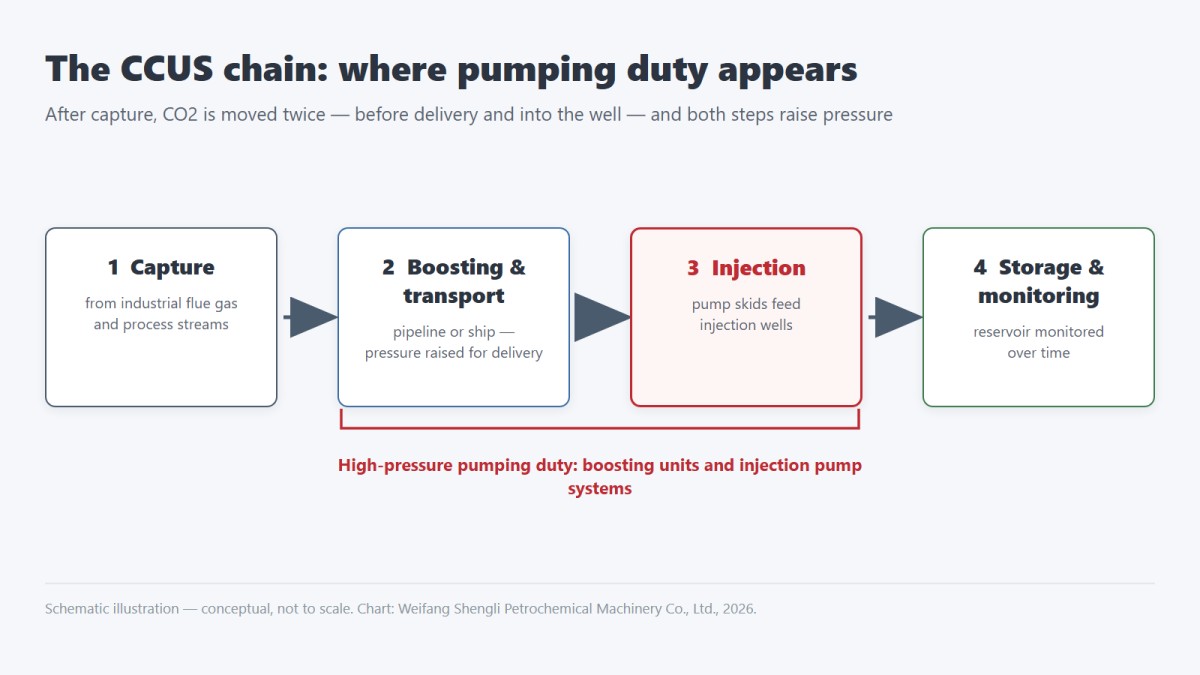
Why injection matters: where pumps enter the CCUS chain
Once CO2 has been captured, a CCUS project lifts it twice. The first lift raises the pressure so the stream can enter a pipeline or a ship; the second drives it from the delivery point into the injection well. Each stage has its own inlet conditions, set by pipeline specifications or reservoir requirements, and each therefore needs boosting upstream of it. High-pressure pumping equipment exists precisely for this duty.
In the demonstration era, such duty appeared once per project and was engineered individually. A pipeline of 266 transport and storage developments rewrites that arithmetic. The same categories of equipment — skidded boosting units and injection pump systems complete with instrumentation and controls — will be bought over and over, by different owners under different contracts. Equipment once designed case by case starts moving as a repeatable package. For a supplier, the defining question changes: no longer "can you build one", but "can you deliver the same machine, with the same documentation, into different countries".
CO2 near its critical point: what it means for pump duty
CO2 does not behave like the fluids most pump specifications are written around. Its critical point sits at 31.1 °C and 7.38 MPa (NIST property data).*5 Close to that point, minor shifts in temperature or pressure translate into large changes in density and phase behaviour, so one and the same stream may act as a liquid, a dense phase, or a fluid approaching supercritical conditions, depending on where it stands in the chain.
Four practical requirements follow for the pump. First, suction must be managed: near the phase boundary, unstable suction causes flashing and cavitation, so NPSH margins have to be worked through carefully. Second, wetted materials must keep their toughness in cold service, because depressurization chills the fluid. Third, water content deserves attention — dissolved in CO2, it forms carbonic acid and raises corrosion questions for internals and seals. Fourth, the sealing arrangement has to cope with a fluid that can change phase inside the machine itself.
Whether a pumping scheme or a compression scheme suits a given duty depends on phase and pressure class. At some operating points the two are alternatives, and the boundary has to be calculated case by case. What holds everywhere is simpler: the equipment must be selected against the actual phase envelope, never against a generic fluid.
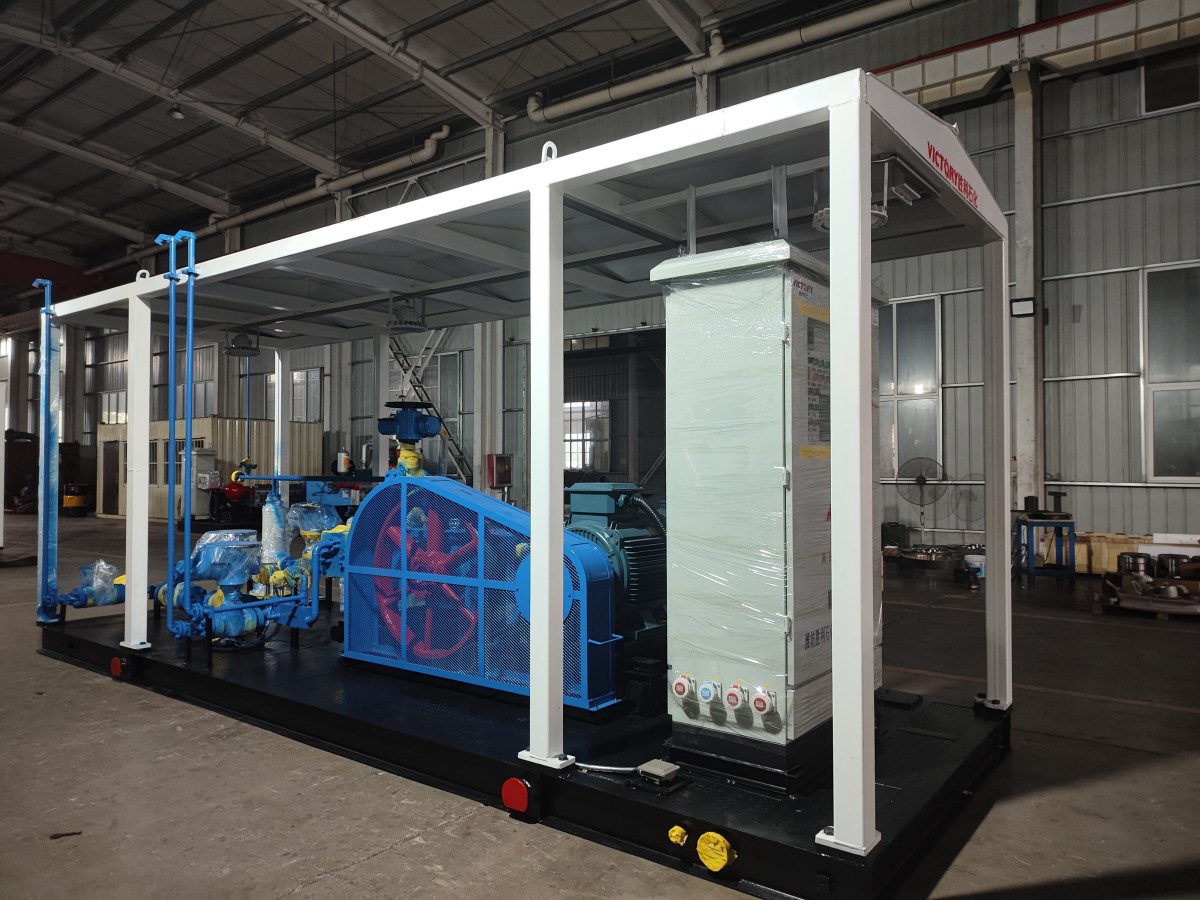
Shared infrastructure: a different buyer for pump packages
The second structural shift is in who signs the purchase order. Norway's Northern Lights took its first CO2 in August 2025; phase one is designed to transport and store 1.5 million tonnes per year, with injection into a reservoir roughly 2,600 metres beneath the North Sea seabed, and bio-sourced CO2 has since joined the stream.*4 In Iceland, the Silverstone project applies Carbfix technology — CO2 dissolved in water and mineralized in basalt — and injected more than 19,000 tonnes between July 2025 and June 2026 after coming on stream in 2025.*4
Their common feature is open access. Once transport and storage run as a service for many emitters — and, if the Asia-Pacific export concepts mature, across borders — the party buying the injection pump stops being a single plant owner. It becomes an infrastructure operator or service company that buys by the package, weighing standardized interfaces, remote monitoring, spare-parts availability and response time on a par with the pump curve. Suppliers who can evidence reliability and support across borders are the ones positioned to win that business.
Three observations for suppliers: what scale-up changes
Everything above reports figures from cited sources. The three points that follow are our own reading of those figures — observations, not forecasts.
First, a batch procurement window is opening for injection and boosting equipment. As transport and storage projects advance together, pump packages will be specified again and again rather than once, which favors suppliers whose designs are proven and repeatable.
Second, the screening criteria will tilt toward life-cycle cost and local service. Under a service-based infrastructure model, an outage at the injection site is an outage for every emitter connected to it, so buyers will weigh response time, spares and documentation — not only unit price.
Third, as measurement, reporting and verification (MRV) frameworks mature, reliability records become a competitive asset in their own right: a documented history of uptime on CO2 duty is difficult for a buyer to ignore and equally difficult for a competitor to copy.
FAQ
Q1. In a CCUS project, is CO2 pumped or compressed?
A: It depends on the phase and the pressure class. Liquid or dense-phase CO2 at moderate pressure differentials can be handled by high-pressure reciprocating pumps; gaseous CO2 with large pressure differentials is traditionally compressed. Near the critical point, the choice must be evaluated project by project; the boundary differs from case to case.
Q2. What is the most overlooked factor in CO2 injection pump selection?
A: The suction side — NPSH margin and the corrosion resistance of wetted parts in CO2 containing water or impurities. Unstable suction near the critical point leads to flashing and cavitation.
Q3. Does shared storage infrastructure change equipment procurement?
A: Yes. When transport and storage are provided by an independent operator, procurement emphasizes standardized interfaces, remote monitoring and spare-parts response rather than unit price alone.
Superscript *n marks the numbered sources cited in the text. Entries are given in their original language; numbering is identical across the English, Chinese and Russian versions.
*1 Global CCS Institute, Global Status of CCS 2026 (data as of 31 July 2026); figures as cited in ref. *4.
*2 International Energy Agency (IEA), analysis on financing CCUS at scale, 2026; figures as cited in ref. *4.
*3 Xodus, Asia-Pacific CCUS regional assessment; figures as cited in ref. *4.
*4 《全球CCUS产业正迈向规模化发展关键阶段》,中国石化报/中国石化新闻网(国际二氧化碳捕集利用封存技术创新合作组织秘书处供稿),2026-11-12。http://www.sinopecnews.com.cn/xnews/content/2026-11/12/content_7160534.html
*5 NIST Chemistry WebBook: carbon dioxide critical-point properties (critical temperature 31.1 °C, critical pressure 7.38 MPa).
*6 中国地质调查局发展研究中心等 4 家机构联合编著《CCS产业发展报告(2026)》;转引自 ref. *4。
Related Posts
Online Message